
In over two decades of advising on transactions across banking, capital markets, and business valuation, I have watched more deals die in due diligence than at any other stage.
Not because the businesses were bad. Not because the buyers were unreasonable. But because the seller, a capable, intelligent promoter who built a genuinely valuable company, was simply not prepared for what the process would ask of them.
Due diligence is the moment when a buyer stops listening to your story and starts verifying it. Every financial statement is cross-checked. Every contract is reviewed. Every regulatory filing is examined. And every gap, every inconsistency, every undisclosed liability, every number that does not reconcile, becomes either a negotiating lever against you or a reason to walk away.
The data confirms what I have observed first-hand. The Axial Dead Deal Report (2025), which analysed 75 failed transactions,found that diligence findings and EBITDA discrepancies together accounted for nearly half of all deal failures.
A broader Acquisition Stars study (May 2026), drawing on Deloitte, McKinsey, and academic research, placed inadequate due diligence as the cause of 31% of M&A failures globally.
Wharton’s analysis (December 2025) was more pointed, noting that deals with thorough diligence (90+ days) have a 34% higher success rate than those rushed through in under 45 days.
None of this surprises me. What surprises me, still, after all these years, is how many promoters enter a transaction without having spent a single day preparing for what is, in most cases, the largest financial event of their lives.
This article is my attempt to change that. It is written for Indian business owners with ₹10 crore to ₹200 crore turnover who are approaching a sale, a fundraise, or a strategic partnership. It covers what due diligence actually entails, what I have seen trip up even well-run businesses, how the regulatory landscape has shifted in 2026, and exactly what you need to have ready, illustrated with practical examples, formulas, and scenarios drawn from real transaction dynamics.
The Gap That Costs Crores: A Practical Illustration
Let me begin with a scenario I have seen play out, in different forms, dozens of times.
A promoter runs a ₹75 crore revenue chemical manufacturing business. EBITDA, as per the audited financial statements, is ₹10 crore. A buyer applies an 8× multiple and makes an indicative offer of ₹80 crore enterprise value. The promoter is pleased.
Then due diligence begins. The buyer’s financial advisor conducts a Quality of Earnings review and identifies the following adjustments:
| Item | Amount | Explanation |
| Promoter’s personal car lease expensed through the company | ₹18 lakh/year | Not a business expense, add back to EBITDA |
| One-time insurance recovery booked as revenue | ₹65 lakh | Non-recurring, deduct from EBITDA |
| Rent paid to promoter’s family trust, above market rate | ₹30 lakh/year (₹12 lakh excess over market) | Related-party adjustment, deduct excess |
| Revenue from a project that was delivered but disputed by the client | ₹45 lakh | Uncertain collectability, deduct |
| Personal staff (driver, gardener) on company payroll | ₹8 lakh/year | Owner benefit, add back |
Net adjustment: EBITDA reduces by approximately ₹95 lakh
The reported EBITDA of ₹10 crore becomes an adjusted EBITDA of approximately ₹9.05 crore. At the same 8× multiple:
Revised Enterprise Value = ₹9.05 crore × 8 = ₹72.4 crore
The promoter just lost ₹7.6 crore in enterprise value, not because the business is bad, but because the earnings contained items that a buyer cannot rely on going forward.
Now, here is the part that makes it worse. The ₹18 lakh car lease and the ₹8 lakh personal staff would have been add-backs in the promoter’s favour if they had been identified and presented proactively in the Information Memorandum. Instead, the buyer’s team discovered them, and the discovery created a trust deficit that coloured the rest of the diligence.
The formula every promoter should understand:
Deal Value = Adjusted EBITDA × Multiple – Net Debt + Surplus Cash ± Working Capital Adjustment
Each component is tested during due diligence:
- Adjusted EBITDA is determined by the buyer’s Quality of Earnings review, not your audited P&L
- Multiple is influenced by industry benchmarks, growth prospects, and the risk factors uncovered during diligence
- Net Debt includes all borrowings, guarantees, and off-balance-sheet obligations discovered during DD
- Working Capital Adjustment is calculated against a normalised “peg”, if your working capital at closing is below the peg, the buyer deducts the shortfall from the price
Every gap the buyer finds in due diligence either reduces the numerator (adjusted EBITDA), lowers the multiple (risk perception), or increases the deductions (hidden debt, working capital shortfall). The maths is relentless.
The Uncomfortable Truth About Indian Mid-Market Businesses
Let me say something that most advisors will not say directly.
The majority of Indian companies in the ₹10 crore to ₹200 crore range are run well enough to generate profits, serve customers, and grow steadily. But they are not run at the level of documentation, governance, and financial formality that a transaction process demands.
This is not a criticism. It is a structural reality. When you are managing daily operations, handling 200 employees, and personally overseeing key client relationships, you do not think about whether your board resolutions are filed correctly, whether your related-party transactions are at arm’s length, or whether your employment contracts comply with the four Labour Codes that came into force in November 2025.
You think about cash flow, orders, and execution. As you should.
But when a buyer enters the picture, particularly a PE fund or a strategic acquirer with a professional deal team, they bring a lens that is entirely different from how you have been managing the business. They are not looking at whether the business works. They are looking at whether it is documentably, verifiably, legally and financially clean.
A practical way to think about this:
Imagine your business has to pass three tests simultaneously:
| Test | What It Asks | Who Typically Fails |
| The CA’s Test | Are your financials accurate, audited, consistent, and tax-compliant? | Companies with informal cash flows, unaudited years, or pending tax disputes |
| The Lawyer’s Test | Are your contracts, licences, IP, and compliance records complete and current? | Companies with expired licences, unsigned amendments, or undocumented IP |
| The Investor’s Test | Can this business generate the same or better returns without the current promoter? | Companies with high founder dependency, customer concentration, or key-man risk |
Most mid-market Indian companies pass one or two of these tests. Very few pass all three without preparation. The ones that do are the ones that close quickly, at full value, with minimal post-closing adjustments.
What Due Diligence Actually Looks Like: The Four Streams
For those who have not been through the process, let me describe what happens when a buyer commences due diligence.
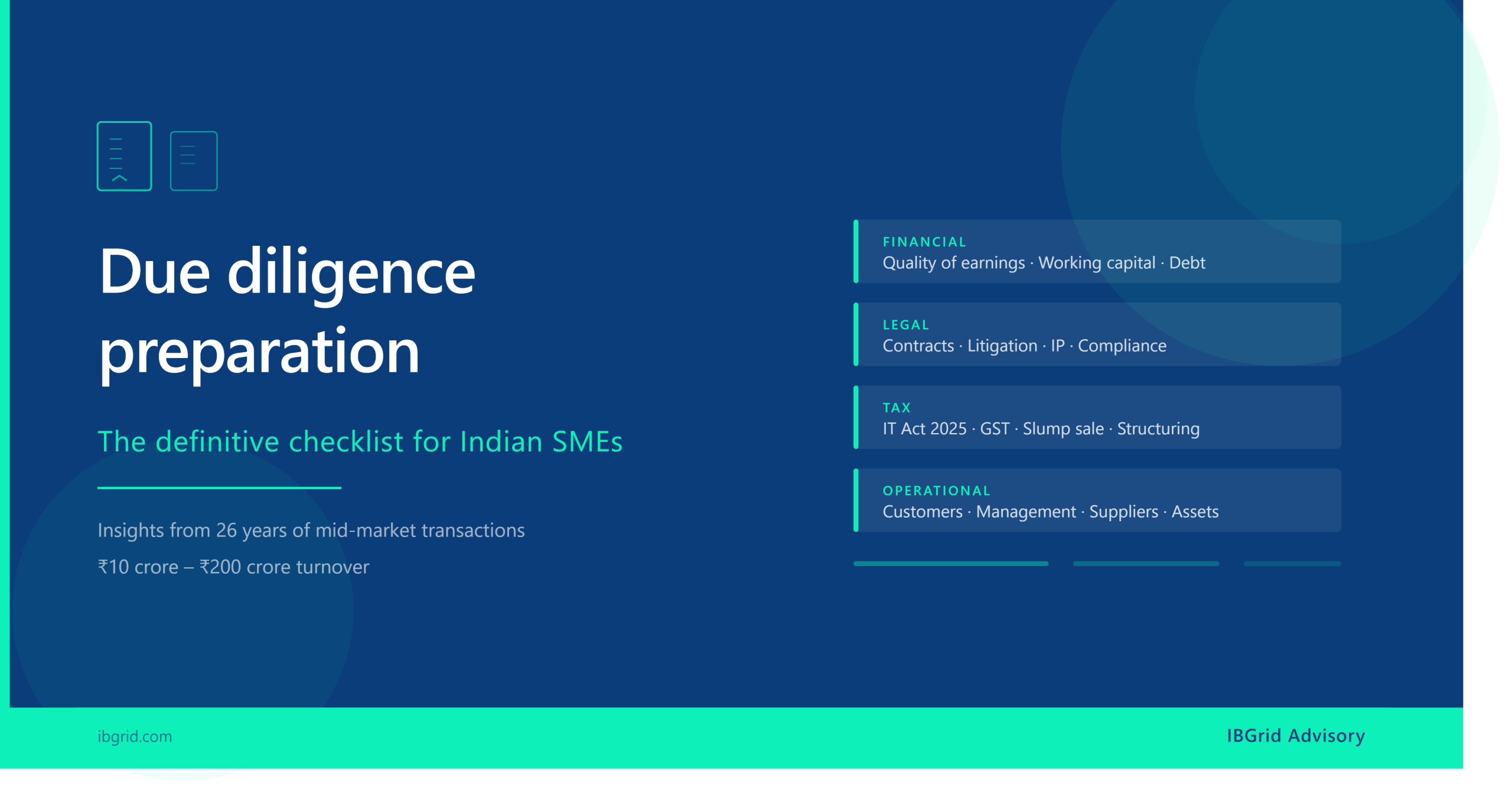
The buyer’s team, financial advisor, legal firm, tax consultant, and sometimes a sector specialist, works through four parallel streams over four to eight weeks.
Stream 1: Financial Due Diligence
The centrepiece is the Quality of Earnings (QoE) analysis. Let me walk through what this involves, because it is the single most consequential element of the entire process.
The buyer’s financial advisor takes your audited P&L and reconstructs the EBITDA line by line. They are looking for:
Non-recurring items.
Revenue or expenses that occurred once and will not repeat. A one-time contract worth ₹1.5 crore that inflated last year’s revenue. An insurance recovery of ₹40 lakh. A legal settlement expense of ₹25 lakh. These are identified and adjusted, upward or downward, to arrive at a “normalised” EBITDA that reflects what the business generates on a sustainable, repeatable basis.
Owner-related adjustments.
Expenses that benefit the promoter personally but are run through the company. Personal vehicle leases, family members on payroll without clear roles, club memberships, travel that is partly personal. In a seller-friendly QoE (which you should commission yourself), these are “add-backs” that increase adjusted EBITDA. But they must be identified proactively, not discovered by the buyer.
Related-party transaction adjustments.
If the company pays rent to a property owned by the promoter’s family, the buyer will compare that rent to the market rate. If the company buys raw materials from a promoter-related entity, the buyer will check whether the pricing is at arm’s length. Any excess is adjusted.
Revenue recognition review.
The buyer checks whether revenue is being recognised in the correct period, whether there are any “channel stuffing” patterns (pushing sales into a period to inflate numbers), and whether receivables are genuinely collectible.
Here is a simplified QoE framework:
Reported EBITDA (from audited P&L) + Owner add-backs (personal expenses through the business) + Non-recurring expense add-backs (one-time costs) – Non-recurring revenue deductions (one-time gains) – Related-party adjustments (excess over market) – Revenue recognition adjustments = Adjusted EBITDA (what the deal is priced on)
In my experience, the typical gap between reported and adjusted EBITDA in Indian mid-market deals is 8 to 20 percent. Sometimes in the promoter’s favour (when add-backs exceed deductions), more often against.
The working capital peg, a concept most promoters do not understand until it costs them.
Beyond EBITDA, the buyer will calculate the normalised working capital requirement of your business and set it as a “peg” in the transaction agreement. Here is how it works:
Suppose your business requires, on average, ₹12 crore of net working capital (current assets minus current liabilities, excluding cash and debt) to operate normally. This ₹12 crore is set as the peg in the SPA. At closing, the actual working capital is measured. If it is ₹10 crore, ₹2 crore below the peg, the buyer deducts ₹2 crore from the purchase price. If it is ₹14 crore, ₹2 crore above, you receive an additional ₹2 crore.
I have seen promoters lose ₹1 to ₹3 crore in post-closing working capital adjustments simply because they drew down receivables or ran down inventory in the months before closing, not realising it would trigger a price reduction.
Preparation step: Maintain 24 months of monthly working capital data. Identify seasonal patterns. Discuss with your advisor what the normalised peg should be, and manage your balance sheet accordingly in the run-up to closing.
Stream 2: Legal Due Diligence
Legal DD covers corporate structure, contracts, litigation, compliance, IP, and employment. Let me illustrate with the issue I see most frequently overlooked.
The change-of-control problem.
A ₹60 crore auto ancillary company has a long-standing supply agreement with a major OEM, its largest customer, contributing 35% of revenue. The contract, signed eight years ago, contains a clause stating: “This agreement may be terminated by either party upon a change in the controlling ownership of the other party, with 90 days’ notice.”
The promoter never gave this clause a second thought. But during DD, the buyer’s legal team flags it immediately. If the acquisition proceeds, the OEM has the right to terminate a contract representing ₹21 crore in annual revenue.
The buyer now has three options: (a) demand a significant discount to compensate for the risk, (b) make the deal conditional on the OEM providing a waiver, or (c) walk away.
I have seen each of these outcomes. In every case, the situation could have been addressed months earlier if the promoter had reviewed their key contracts for change-of-control clauses and either renegotiated them or obtained advance waivers.
Preparation step: Review every contract above ₹50 lakh in annual value, and every contract with your top 10 customers and top 5 suppliers. Identify change-of-control, termination, and assignment provisions. Address them before going to market.
Stream 3: Tax Due Diligence
Tax DD has become significantly more complex since April 2026. Let me illustrate why.
The new Income Tax Act, 2025, a practical example.
Suppose the transaction is structured as a slump sale, the transfer of your entire business undertaking for a lump sum. Under the old Act (1961), capital gains were governed by Section 50B, with FMV computed under Rule 11UAE.
Under the new Act (effective 1 April 2026), slump sale capital gains are now governed by Section 77, with FMV computed under Rule 53. The critical change: Rule 53 mandates two separate FMV computations:
FMV1 = Net asset value method (aggregate of all assets minus liabilities) FMV2 = Consideration-based method (actual sale price or imputed consideration) Applicable FMV = Higher of FMV1 or FMV2
If the sale consideration exceeds the net asset value, which it usually does in a profitable business, FMV2 governs, resulting in a higher capital gains figure.
Worked example:
| Component | Amount |
| Sale consideration (lump sum) | ₹45 crore |
| Net asset value of undertaking (FMV1) | ₹28 crore |
| FMV2 (consideration-based) | ₹45 crore |
| Applicable FMV (higher of FMV1/FMV2) | ₹45 crore |
| Net worth of undertaking (cost of acquisition) | ₹15 crore |
| Long-term capital gains | ₹30 crore |
| Tax at 12.5% (LTCG, if held > 36 months) | ₹3.75 crore |
Under the old Act’s Rule 11UAE, the FMV computation methodology differed, and depending on the specific facts, the resulting capital gain could have been lower.
The key change under the new Act is the mandatory dual computation and the “higher of” rule, which in scenarios where sale consideration significantly exceeds net asset value, tends to result in a larger capital gains figure.
The precise impact varies by transaction; what does not vary is the need to compute under the correct Act. A tax advisor who runs a post-April 2026 slump sale through old Rule 11UAE templates will produce an incorrect result.
As PwC India documented, the transitional provisions between old and new regimes require careful mapping. A valuation report citing Section 50B for a post-April 2026 transaction is not just outdated, it is incorrect and creates compliance risk.
Additionally: Section 116 of the new Act restricts post-merger loss carry-forward to the remaining years of the original 8-year period. If a target company has ₹5 crore in accumulated losses with only 3 years remaining on the carry-forward clock, a merger does not reset the clock. This directly affects the deal economics for buyers who intended to use those losses.
Preparation step: Have your tax advisor map every relevant position to the new Act before the transaction. Structure the deal (share sale vs slump sale vs asset sale) with full awareness of the 2026 implications. Do not rely on pre-April 2026 templates.
Stream 4: Operational and Commercial Due Diligence
This is where qualitative factors are assessed. Let me illustrate with the issue that most consistently compresses mid-market valuations.
The customer concentration penalty, with real maths.
Consider two companies in the same sector, both with ₹8 crore EBITDA:
| Factor | Company A | Company B |
| Top customer as % of revenue | 42% | 12% |
| Top 5 customers as % of revenue | 78% | 38% |
| Customer contracts (binding) | None (relationship-based) | 3-year contracts with renewal |
| EBITDA multiple offered | 6× | 9× |
| Enterprise value | ₹48 crore | ₹72 crore |
Same EBITDA. ₹24 crore difference in enterprise value.
Company A’s buyer sees a business where losing one relationship eliminates 42% of revenue overnight, with no contractual protection. That risk is priced into the multiple. Company B’s buyer sees diversified, contracted revenue with visible stability. They pay a premium for that certainty.
The founder dependency discount, another illustration.
A buyer asks: “If the promoter left tomorrow, what would happen to this business in the next 12 months?”
| Scenario | Likely Multiple Impact |
| Business continues normally; management team is capable and empowered | No discount |
| Some disruption, but recoverable within 3–6 months with transition support | 0.5× to 1× discount |
| Significant client relationships, pricing decisions, and operational knowledge reside with the promoter; business would struggle | 1.5× to 2.5× discount |
| Business would not survive 6 months | Deal unlikely to proceed |
On an ₹8 crore EBITDA business, a 2× multiple discount is ₹16 crore in lost enterprise value. That is the cost of not building a second line of management.
Preparation step: Begin addressing founder dependency 2 to 3 years before a transaction. Delegate client relationships. Document pricing and operational decisions. Empower department heads. This is not a quick fix, which is exactly why starting early matters.
What Has Changed in 2026, And Why It Matters
The regulatory framework governing Indian M&A due diligence has changed more in the past three years than in the previous decade. Beyond the tax changes illustrated above, promoters preparing for a transaction need to understand:
The four Labour Codes
Came into force on 21 November 2025, consolidating 29 earlier laws. The most material change: a uniform definition of “wages” that sets a floor of 50% of total remuneration as basic wages. This cascades into PF, ESI, gratuity, and full-and-final calculations. AsiPleaders (July 2026) documented, buyer legal teams now specifically check whether the target is compliant. Non-compliance is a quantifiable liability, and I have seen it range from ₹20 lakh to ₹2 crore depending on workforce size and the duration of non-compliance.
The Competition (Amendment) Act, 2023
Introduced deal-value thresholds. Transactions exceeding ₹2,000 crore involving entities with significant operations in India require mandatory CCI notification. Penalties for non-compliance can reach 1% of deal value, perRNC Valuers (May 2026). For mid-market sellers, this is most relevant when the acquirer is a large strategic player, the combined transaction value may cross the threshold even if your business does not.
Warranty & Indemnity insurance
Is reshaping deal mechanics. PE firms accounted for 92% of W&I claims in India in 2025, perWhalesbook (June 2026), with tax and regulatory compliance being the dominant claim areas.Kennedys Law (March 2026) noted that deal teams in 2026 integrate W&I strategy from the diligence scoping stage itself.Norton Rose Fulbright found 65% of dealmakers expect W&I usage to increase.
Why this matters to you as a seller: Issues identified during DD are excluded from W&I coverage. A clean DD outcome expands the buyer’s insurance coverage, increases their confidence, and strengthens your negotiating position. A messy DD creates exclusions, delays, and price compression. Your preparation literally shapes the insurance terms that underpin the deal.
The Preparation Checklist
Financial Preparation
Audited financial statements for 3 to 5 years. This is non-negotiable. I have seen businesses gain 15 to 20% in effective valuation simply by having three clean years of audited accounts compared to peers that could not produce them.
Sell-side Quality of Earnings analysis. Commission this before any buyer examines your numbers. Frame the narrative proactively. The ₹18 lakh car lease that a buyer discovers is a trust breach. The same ₹18 lakh car lease that you disclose upfront as an owner add-back is a normalisation adjustment that increases your EBITDA.
Working capital data. 24 months of monthly data, receivables ageing, inventory, payables. Know your normalised peg.
Complete debt schedule. Every borrowing, guarantee, and off-balance-sheet commitment. Undisclosed debt is treated as a breach of trust.
Tax compliance records. All returns, assessments, demands, and disputes, mapped to the new Income Tax Act, 2025 where the effective date crosses the 1 April 2026 threshold.
Legal Preparation
Corporate documents. Incorporation certificates, current MOA/AOA, board and shareholder resolutions, register of members, complete shareholding history.
Material contracts. Every contract above ₹50 lakh in annual value. Review specifically for change-of-control, termination, and assignment clauses.
Litigation. Complete register of all pending, threatened, or concluded matters. I will say this plainly: in 26 years, I have never seen a deal survive the discovery of material undisclosed litigation.
Regulatory licences. Every licence and permit required for operations, confirmed as current, valid, and transferable upon change of control.
IP ownership. All registered and unregistered IP, with confirmed ownership chains, particularly where IP was created by contractors or employees without formal assignment.
Employment compliance. Mapped to the four Labour Codes (effective November 2025). Verify compliance with the new wage definition, PF/ESI contributions, gratuity calculations, POSH committee documentation.
Data protection. Compliance with DPDP Act and Rules, consent mechanisms, privacy notices, data processor agreements, breach history.
Operational Preparation
Customer concentration. Revenue by customer for 3 to 5 years. No single customer above 15%.
Management depth. An honest answer to the question: “Can this business operate for 6 months without me?” If the answer is no, start fixing it now, not in the IM.
Supplier map. Single-source dependencies identified, with alternatives assessed.
Asset register. Updated, with condition assessments and capex requirements. Deferred maintenance that the buyer must fund reduces the effective price.
The Virtual Data Room
Organise by category: Corporate, Financial, Tax, Legal, Contracts, Employment, IP, Regulatory, Operations, Property. Every document clearly labelled, in searchable PDF format. Populate it before the buyer gets access.
A well-organised data room on Day 1 tells the buyer: this promoter is serious, professional, and has nothing to hide. An incomplete one that gets filled reactively tells them the opposite. I have seen buyer confidence shift permanently based on the quality of the data room in the first 48 hours.
The Preparation Timeline
| When | What to Do |
| 18–24 months before | Professional valuation. 3–5 years of audited financials. Sell-side QoE. Resolve litigation. Review contracts for change-of-control. Build management depth. Map compliance to new Labour Codes, DPDP Act, and IT Act 2025. |
| 6–12 months before | Engage M&A advisor. Prepare IM and financial model. Populate data room. Update asset register. Confirm licences. Engage tax advisor on deal structuring. |
| At transaction | Data room 90%+ complete. All disclosures proactive and thorough. Q&A log maintained for buyer queries. |
The Market Context: Why This Matters More in H2 2026
India’s deal market in 2026 is defined by more capital chasing fewer, better-prepared businesses.
LSEG (July 2026) reported India’s M&A deal value reached US$86.9 billion in H1 2026, up 31% year-on-year, while deal volumes fell 8%. Grant Thornton’s Q2 2026 Dealtracker recorded M&A values up 302% quarter-on-quarter. PE investments totalled US$8.7 billion in H1 2026, with investors clearly preferring mature, operationally sound businesses. Bain’s India PE Report 2026 confirmed the shift: PE firms are prioritising operational improvement and governance over multiple expansion.
As Khaitan & Co (March 2026) observed, the current environment rewards preparedness, realism, and execution quality.
I would add one thing to that: in a selective market, the promoter who has invested in DD preparation does not just close faster and at a better price. They negotiate from confidence rather than anxiety. They control the narrative rather than reacting to findings. And they arrive at closing without the regret that comes from feeling the process ran away from them.
A Quick Self-Assessment: How Ready Is Your Business?
Before you engage an advisor, answer these ten questions honestly. Score yourself one point for each “yes.”
| # | Question | Yes/No |
| 1 | Do you have 3+ years of audited financial statements from a reputed CA firm? | |
| 2 | Do you know your adjusted EBITDA (after removing non-recurring and owner-related items)? | |
| 3 | Can your business operate for 6 months without you personally managing it? | |
| 4 | Is your largest customer below 15% of total revenue? | |
| 5 | Have you reviewed your key contracts for change-of-control clauses? | |
| 6 | Are all regulatory licences and permits current and valid? | |
| 7 | Do you have a complete register of all pending and concluded litigation? | |
| 8 | Are your employment contracts and contributions compliant with the 2025 Labour Codes? | |
| 9 | Is your IP formally registered and assigned to the company (not to individuals)? | |
| 10 | Can you produce a complete, organised data room within 30 days if needed? |
Scoring:
- 8–10: You are likely ready for a transaction. Engage an advisor and move forward.
- 5–7: You have a solid foundation but meaningful gaps that need 6 to 12 months to address. Start now.
- Below 5: You are 18 to 24 months away from being transaction-ready. That is not a problem, it is a plan. Begin with a professional valuation and an honest gap analysis.
A Final Observation
In 26 years of advising on transactions, I have never seen a promoter regret being overprepared for due diligence. I have seen many regret the opposite.
The businesses that command the best valuations, attract the most capable buyers, close in the shortest timelines, and produce the most satisfied sellers are not necessarily the largest or the fastest-growing. They are the best-prepared.
Preparation is not glamorous. It does not involve clever financial engineering or aggressive negotiation. It involves audited statements, organised data rooms, resolved litigation, diversified client bases, empowered management teams, and honest self-assessment.
It is, in my experience, the single most valuable investment a promoter can make before entering a transaction.
How IBGrid Supports This Process
At IBGrid, due diligence preparation is embedded in our advisory process from engagement. We begin with a readiness assessment, identify gaps, and work with the promoter’s team to address them before the business goes to market. We commission sell-side QoE and legal reviews where appropriate. We structure and populate the data room. And we manage the buyer’s DD process through to close.
Our objective is simple: by the time a buyer enters the data room, there should be no surprises.
For a confidential discussion about your transaction readiness, our team can be reachedhere. For a preliminary valuation, IBGrid offers a free Valuation Calculator.