

The top- known investment banking companies in India include domestic houses like IBGrid, Kotak Investment Banking, Axis Capital, ICICI Securities, JM Financial, and IIFL Capital; global banks such as J.P. Morgan, Morgan Stanley, Citi, and Jefferies; and specialist advisors like Avendus, o3 Capital, and Equirus. The right one for you depends mostly on deal size. Global banks lead large IPOs and cross-border deals. Domestic houses cover listings and large private deals. Boutiques and tech-led advisors handle most private sales and fundraises below ₹500 crore.
Say you have spent 20 years building a manufacturing business and a larger company wants to buy it. Or your business needs ₹200 crore to expand, and you don’t want to give away more equity than you must. In both cases, the banker you pick shapes the price, the terms, and the timeline.
This guide explores 13 investment banking companies worth knowing, the services they offer, and how to identify the right fit for your business.
Q3 2026: a broad, healthy quarter
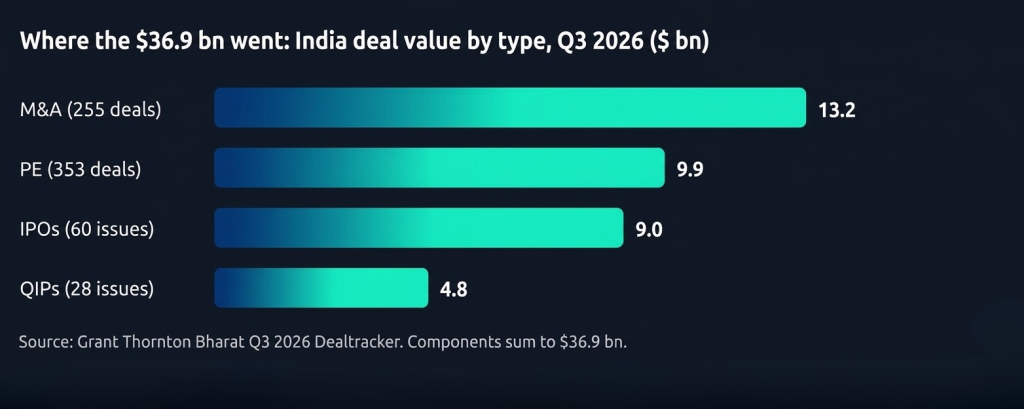
Grant Thornton Bharat recorded 696 deals worth $36.9 bn in July-September. M&A was volume-led with 255 deals worth $13.2 bn, private equity hit a 2026 high of $9.9 bn across 353 deals, and IPO plus QIP fundraising of $13.8 bn exceeded total M&A value.
- Sectors by value: energy and natural resources (38 deals, $3 bn)
- Banking and financial services (58 deals, nearly $3 bn), infrastructure management (26 deals, $2.8 bn).
- Financial services: 67 deals worth $7.3 bn, up 129% on Q2, with PE/VC cooling to $736 mn.
- Autos: 33 deals worth $1.7 bn, with EVs making up 54% of M&A and PE activity.
The top 13 investment banking companies in India
1. IBGrid: Best for startups, SMEs and mid-market promoters
An investment banking company in Ahmedabad and a subsidiary of IndiaBizForSale that pairs technology, a proprietary investor and buyer network and experienced bankers. We aim to complete transactions in just 120-180 days.
- What it does: Fundraising advisory, business exit services, business valuation, M&A advisory and related strategic support.
- Why consider it: SMEs and mid-market businesses often need an adviser who understands promoter priorities, ownership structures, valuation expectations and transaction preparation. IBGrid’s published service range is specifically relevant to businesses exploring capital raising, acquisitions or a business exit.
- Best for: Promoters of established SMEs and mid-market companies seeking fundraising, valuation or M&A support, particularly those with annual turnover in the firm’s stated ₹25-200 crore range.
- What to ask before appointing: Request completed transaction examples relevant to your industry and deal size, clarify who will manage your mandate and understand the proposed transaction timeline, fees and confidentiality arrangements.
2. Kotak Investment Banking: Best domestic all-rounder
Kotak Investment Banking operates within Kotak Mahindra Bank’s financial services business and is active in equity capital markets and M&A advisory.
Kotak was featured among India’s leading investment bank in equity capital markets advisers in the first nine months of 2025. LSEG data reported by Business Standard placed it fifth in the ECM league table, with an 8.2% share of funds raised during that period. This is historical market-share evidence, rather than a guarantee of current performance across all investment banking services.
- Why consider it: Businesses preparing for an IPO, a qualified institutional placement or a strategic transaction may benefit from evaluating Kotak’s relevant execution experience and domestic market relationships.
- Best for: Established companies and larger businesses evaluating public-market fundraising or corporate transactions.
3. JPMorgan: Best for large IPOs and cross-border deals
JPMorgan led India’s ECM table for the first nine months of 2025, managing $4.98 billion of deals for a 12.1% share. Its global distribution, balance sheet and cross-border reach make it a natural choice where overseas investors matter, such as large IPOs and international transactions.
- Why consider it: Cross-border transactions may require coordination between domestic advisers, international investors, financing providers and legal teams. J.P. Morgan’s global capital-markets capabilities are relevant to companies evaluating such requirements.
- Best for: Large corporates, established issuers and businesses pursuing substantial domestic or international capital-market transactions.
4. Morgan Stanley: Best for marquee listings
Morgan Stanley followed JPMorgan with a 10.5% ECM share in the same period. It is a regular in large technology and financial-sector IPOs and cross-border advisory, and its main edge is deep access to global institutional investors.
- Why consider it: Companies preparing for a significant public offering or a complex strategic transaction may wish to evaluate its sector expertise, institutional investor relationships and execution capabilities.
- Best for: Larger businesses considering public listings, substantial equity transactions or cross-border strategic activity.
5. Citi: Best for cross-border bridge deals
Citi investment banking topped India’s overall fee rankings in H1 2026 with $60.3 million, about 9.8% of a pool that shrank 20%. It was also the top ECM dealmaker in H1 2025, with 11 deals raising roughly $5 billion, and reportedly planned in 2024 to boost investment banking headcount in India. Its treasury and corporate banking links help clients needing financing and advice together.
- Why consider it: Companies with international expansion plans may need an adviser capable of coordinating financing and strategic transactions across multiple markets.
- Best for: Large corporates, multinational businesses and companies considering cross-border acquisitions or substantial fundraising.
6. Goldman Sachs: Best for global investor access
Goldman Sachs offers a global franchise, sector research and a deep network among international institutions, and is usually considered for large IPOs, cross-border M&A and overseas capital raising. We found less recent India-specific league-table data for Goldman than for peers in the sources reviewed.
- Why consider it: Businesses pursuing large acquisitions, significant capital raises or international transactions may wish to evaluate its experience and investor reach.
- Best for: Large companies, mature businesses and businesses with substantial international transaction requirements.
7. Jefferies: Best mid-market global platform
Jefferies led India’s overall fee rankings in the first nine months of 2025 with nearly $86 million, or 8.7% of the pool. It pairs global reach with a more senior-attention feel for mid-sized and upper-mid-market clients, which is why it keeps appearing in both M&A and capital-markets mandates.
- Why consider it: Companies evaluating a substantial capital raise, strategic acquisition or other corporate transaction can assess Jefferies banking alongside other advisers with relevant sector and deal experience.
- Best for: Established companies, financial sponsors and businesses evaluating mid-sized to large corporate transactions, subject to the firm’s current mandate criteria.
8. Axis Capital: Best for ECM and debt markets
The investment banking arm of Axis Bank usually ranks in the top ten for fees, ECM and debt capital markets and Axis Bank led overall fees in Q1 2026. Its parent’s distribution network and corporate relationships are a genuine edge for large raises that mix equity and debt.
- Why consider it: Companies evaluating a public offering or a substantial corporate capital raise can assess its execution experience, sector coverage and proposed distribution strategy.
- Best for: Established businesses and corporate issuers considering capital-market transactions.
9. IIFL Capital: Best for SME and mid-cap listings
IIFL Capital held an 8.3% ECM share in the first nine months of 2025. It is known for SME IPOs and mid-market M&A and is comfortable with smaller issue sizes that larger banks may not prioritise.
- Why consider it: Businesses considering a public listing should evaluate the adviser’s experience with similar issuers, its approach to investor positioning and its support during the listing process.
- Best for: Companies exploring IPOs or other equity-market transactions, including eligible small and mid-sized issuers.
10. Avendus Capital: Best for tech and startup deals
Avendus is a go-to name for technology and startup M&A investment banking, private equity fundraising and equity capital markets. Founders of software, internet, fintech and consumer businesses often use it for sell-side mandates and late-stage rounds.
- Why consider it: A company seeking growth capital or evaluating strategic alternatives may need an adviser who can explain investor expectations, transaction structures and the preparation required before approaching counterparties.
- Best for: Established and growth-oriented companies evaluating private capital or M&A transactions, subject to the firm’s mandate criteria.
11. JM Financial: Best for long-standing promoter relationships
JM Financial is among the older homegrown houses, associated with complex debt solutions and promoter-led businesses. Reporting has noted its rise in ECM league tables amid growing small and midcap activity.
- Why consider it: Companies evaluating a strategic transaction or capital raise can assess its relevant industry expertise, execution approach and experience with promoter-led businesses.
- Best for: Established Indian businesses considering corporate transactions or capital-market activity.
12. ICICI Securities: Best for distribution power
ICICI Securities combines institutional execution with broad retail and institutional distribution through its group. Its investment banking work has covered financial services, energy, retail and technology issuers, which matters when you want broad investor participation in an offer.
- Why consider it: Companies considering a public offering should assess the firm’s experience with similar issuers, its investor outreach strategy and the support available throughout the listing process.
- Best for: Businesses preparing for an IPO or evaluating other equity-market transactions, where eligible and appropriate.
13. o3 Capital: Best boutique for mid-market M&A
o3 Capital is a boutique investment firm focused on mid-market M&A in healthcare, manufacturing and consumer sectors. Because its mandates are not overshadowed by larger clients, promoters selling a mid-sized business can expect closer partner involvement.
- Why consider it: Companies that need transaction-specific advice may benefit from comparing a specialist adviser with larger investment banking platforms.
- Best for: Businesses evaluating M&A or capital-raising mandates that fit the firm’s current sector coverage and transaction criteria.
How much do investment bankers charge in India?
Most investment bankers in India charge a success fee, a percentage of the deal value paid only when the deal closes. Many also charge a retainer up front. There is no standard price list, but most mandates combine a few building blocks:
- Retainer: a monthly or upfront fee covering preparation work such as valuation, materials and outreach. Ask whether it is credited against the success fee.
- Success fee: paid when the deal closes, usually a percentage of transaction value. Smaller deals often carry a higher percentage.
- Underwriting or placement fees: for IPOs, QIPs and bonds, paid by the issuer and typically disclosed in offer documents.
- Expenses: legal, travel and data-room costs, often charged on top.
Read these terms before you sign:
- Exclusivity: how long you cannot hire another advisor. Three to six months is common; longer needs milestones attached.
- Tail clause: whether you still owe a fee if you close with a buyer the banker introduced, after the mandate ends, and for how long.
- Expenses: travel, data room and legal costs, and whether they are capped.
- Retainer adjustment: whether the retainer is deducted from the success fee.
- If the deal fails: what you owe, if anything, beyond the retainer.
How the process works and how long it takes
Duration depends on preparation, how many buyers or investors engage, negotiations, due diligence and regulatory approvals. Many private deals take several months, and IPOs need significant preparation before the formal process begins.
Over the years, IBGrid has developed a structured approach to managing business transactions, from initial preparation and market outreach to negotiations and closure. The process below reflects the key stages involved in taking a business through a fundraising or M&A deal.
- Prepare: We will prepare professional-grade business collateral for your company to build a great story for your business transaction.
- Market: With our 200,000+ professional network, we can attract multiple potential investors for your business within weeks.
- Qualification & Management Meetings: Our investment banking partner will arrange management meetings with qualified parties on the other side.
- Negotiation and structuring: We will lead the negotiation and deal structuring of your transaction, working closely with all stakeholders.
- Due diligence and Closure: Our team will facilitate the due diligence process and documentation to drive a seamless and successful closure.
What to prepare before you call a banker?
The better prepared you are, the better the terms you get and the faster the deal closes. Have these ready before the first meeting:
- Financials: three years of audited accounts and current management information.
- Ownership documents: a clean cap table, shareholder agreements and key contracts.
- Compliance snapshot: tax, statutory filings and any litigation.
- Business story: customers, margins, growth drivers and risks.
- Your objective: how much capital or what price, what stake you will part with and your deal-breakers.
- Confidentiality plan: who in your team knows, and an NDA before sharing data.
How to choose: Questions to ask any banker
Choosing an investment banker for a business sale, fundraising or M&A deals requires more than reviewing their credentials or the size of their previous deals. The right adviser should understand your business, have access to relevant buyers or investors, explain their valuation approach and provide clarity on how they will manage the transaction.
Before signing an engagement letter, ask these seven questions to assess whether the banker is equipped to handle your specific requirements.
1. What Is Your Median Deal Size?
An investment banker’s experience should align with the size and complexity of your transaction. A firm that regularly handles billion-rupee deals may not necessarily be the right fit for a promoter-owned business seeking a ₹20 crore exit or ₹50 crore in growth capital.
What to look for: Ask about the median transaction value, typical client turnover, industries served and the proportion of deals that fall within your target size. Median deal size is particularly useful because a few exceptionally large transactions can distort the impression created by an average.
Example: If your business is valued at ₹40 crore, ask how many comparable transactions the banker has handled in the ₹20-60 crore range.
2. Which Comparable Deals Have You Closed?
Past transactions can help you assess whether an adviser understands your industry, buyer expectations and the practical challenges involved in closing a deal. However, experience should be measured by completed transactions, not simply mandates received or discussions initiated.
What to look for: Ask for examples of transactions involving similar industries, business sizes, ownership structures and objectives. Where confidentiality permits, request details about the transaction type, approximate deal value, timeline and outcome. You can also ask for references from previous clients, subject to their consent.
For instance, an adviser handling the sale of a manufacturing business should be able to explain experience with strategic buyers, financial investors or industry consolidators, depending on the likely buyer universe.
3. Who Will Actually Work on My Deal?
The senior banker who pitches for your mandate may not be the person managing the transaction. Day-to-day execution often involves analysts, associates and other team members responsible for financial analysis, documentation, buyer outreach and due diligence.
What to look for: Ask for the proposed deal team, each member’s role, their level of experience and the amount of senior-level involvement you can expect. Clarify who will be your primary contact, who will coordinate buyer discussions and who will handle negotiations.
For a promoter-owned business, direct access to an experienced adviser can be especially valuable when discussing valuation expectations, confidentiality, succession or the terms of a potential exit.
4. Which Buyers or Investors Will You Approach, and Why?
A large contact database does not automatically translate into suitable buyers or investors. The quality of the outreach strategy depends on identifying parties with a strategic reason, financial capacity and genuine interest in your business.
What to look for: Ask how the banker will develop the target list and prioritise potential counterparties. Depending on your objectives, the list could include strategic acquirers, private equity firms, family offices, industry consolidators or other relevant investors.
The adviser should explain how potential counterparties will be evaluated based on factors such as:
– Strategic fit with your industry and business model.
– Financial capacity and ability to complete the transaction.
– Previous acquisitions or investments in comparable businesses.
– Potential synergies, growth plans or investment objectives.
– Likely deal structure and compatibility with your expectations.
Also, ask how your identity and sensitive information will be protected during outreach.
5. How Will You Value My Business?
Business valuation is not simply about arriving at the highest possible number. It is about establishing a defensible value range, understanding what drives that value and assessing what potential buyers or investors may realistically be willing to pay.
Ask the banker to explain the valuation methods relevant to your business. As an initial step, you can also use the valuation calculator to get an indicative estimate of your business’s value before discussing a detailed valuation with an adviser.
These may include:
– Comparable company analysis: Evaluating your business against similar listed companies using relevant financial multiples.
– Precedent transaction analysis: Examining valuations and multiples from comparable acquisitions.
– Discounted cash flow (DCF): Estimating value based on projected future cash flows and the associated risks.
The appropriate method will depend on the company’s industry, profitability, growth prospects, asset base and financial reporting quality.
Ask how the adviser will account for debt, surplus cash, working capital, customer concentration, promoter dependence and other factors that could influence the final transaction value.
Example: Two businesses with similar revenue may command different valuations because one has stronger margins, recurring customers, and lower dependence on its founder.
6. How Are You Paid?
Understanding the fee structure upfront helps you evaluate the total cost of the engagement and avoid disagreements later. Investment banking fees can vary depending on the transaction type, size, complexity and scope of work.
7. What Could Delay or Derail This Deal?
A good investment banker should be able to identify potential obstacles before they become expensive problems. Every transaction carries uncertainty, and an adviser who acknowledges risks is often better positioned to help you prepare for them.
What to look for: Ask the banker to identify the three to five most significant risks specific to your business and explain how each could affect the transaction.
Common issues include:
– Incomplete financial records or inconsistent reporting.
– High dependence on the promoter or a small number of customers.
– Unresolved legal, tax, regulatory or ownership matters.
– A valuation expectation that does not match buyer appetite.
– Limited buyer interest or difficulty securing financing.
– Delays in due diligence, approvals or negotiations.
– Disagreement over warranties, indemnities, earn-outs or transition arrangements.
The adviser should also explain what can be addressed before approaching buyers or investors, what documentation needs to be prepared and which risks may remain beyond anyone’s control.
Red flags to watch
Walk away, or at least slow down, if you see any of these:
• A valuation before seeing your numbers: A high figure in the first meeting is a sales tactic, not an assessment.
• A large retainer with no proof of access: If they can’t name the kind of buyers or investors they will approach, you are paying for a search they haven’t started.
• The senior team disappears. Partners pitch, then a junior analyst runs your deal.
• Conflicts of interest: The firm also advises a likely buyer, or earns fees from the investor side.
• Long exclusivity with no milestones: Lock-in with nothing promised in return.
• No relevant deals: They can’t show closed transactions in your sector or size range.
India’s deal market in snapshot
India’s investment banking ecosystem has three layers: global banks for the biggest IPOs and cross-border deals, domestic houses for capital-markets depth, and boutique banks and tech-led advisers for the large middle market. The chart shows how violently deal value swings from year to year.
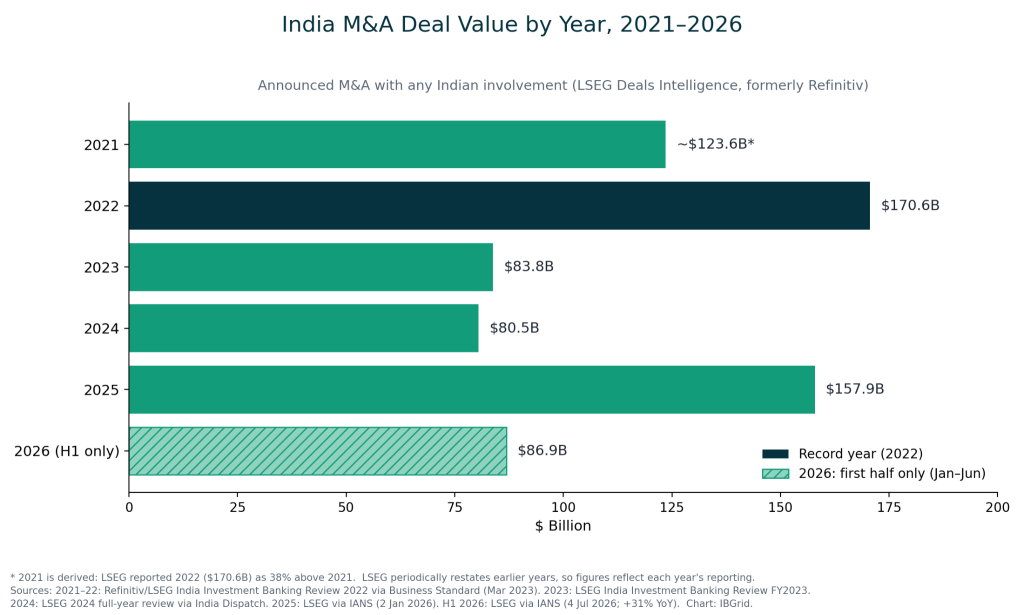
| Insight: A record 2022 was followed by a 51% fall in 2023, a flat 2024 and a near-doubling in 2025. Because a few mega-deals drive each year, quarterly volumes tell you more about the health of the mid-market than headline values do. |
| Why it matters? Large M&A deals tend to carry a smaller fee percentage than IPOs, so bigger deal values do not automatically mean a bigger fee pool. For business owners, thinner fees at the top of the market give mid-sized issuers more room to negotiate. |
Final Thoughts:
Choose the Advisor for the Transaction, Not Just the Name
The best investment banking firm for one company may not be the best for another. A promoter preparing for a business exit, a founder raising growth capital and a listed company planning an IPO have different needs. Start by defining your objective. Then shortlist firms based on relevant experience, transaction size, sector knowledge, the actual team, fees and the support provided through execution.
Frequently Asked Questions
1. What are the top investment banking companies in India?
Investment banking firms in India include specialist advisors such as IBGrid and o3 Capital, domestic financial institutions such as Kotak Investment Banking and JM Financial, and global institutions such as Goldman Sachs, J.P. Morgan and Morgan Stanley. The right choice depends on the transaction, business size, sector and services required.
2. What services do investment banking companies provide?
Services of investment banks can include mergers and acquisitions (M&A), fundraising, IPOs, equity and debt capital markets, structured finance and strategic transaction advisory. The investment banking services available vary by firm, so businesses should check whether the advisor handles their specific requirement. Look for an advisor with experience in comparable transactions and an understanding of it
3. Which investment banking firm is suitable for a small or mid-sized business in India?
A small or mid-sized business should choose a firm with a suitable network of investors or buyers. Specialist advisory firms may be relevant for privately held businesses exploring fundraising, business sales or acquisitions. The final choice should depend on the firm’s mandate fit and demonstrated experience.
4. How do I choose the right investment banking company for fundraising?
Start by defining how much capital you need, how you intend to use it and how much ownership you are willing to offer. Then compare firms based on sector experience, investor relationships, relevant transactions, fees and the support provided during negotiations and due diligence. If you are exploring professional fundraising support, IBGrid’s fundraising advisory services can help you understand the fundraising process and identify a suitable approach for your business.
5. How much do investment banking services cost in India?
Fees vary according to the transaction type, size, scope of work and engagement terms. Some mandates include a retainer, a success-based fee or both. Before signing an agreement, clarify how fees are calculated, which expenses are additional, whether exclusivity applies and what happens if the transaction does not close.
6. How long does an investment banking transaction take?
The timeline depends on preparation, the availability of suitable buyers or investors, negotiations, due diligence, financing and regulatory approvals. Rather than relying on a standard duration, ask the advisor for a milestone-based timeline that reflects your transaction and the factors that could delay completion.
| Not sure which route fits? See how IBGrid can run your deal. Share a brief on your fundraise, exit or acquisition for a confidential response. Book a 20-min call or write to [email protected] |