
We get some version of this conversation every few months: a promoter has a term sheet in hand, the price looks fair, and only after we ask “which structure is this?” do they realise nobody has actually told them. The kind of merger you sign decides your tax bill, your regulatory timeline, and how much of the headline number you actually keep. This is the guide we wish every business owner read before, not after, signing.
Every M&A deal gets called a “merger” in casual conversation, but the thirteen structures behind that word behave nothing alike. Here’s how to tell them apart before you’re three months into due diligence.
That gap is why we wrote this. If you’re weighing a deal right now, the label matters more than it looks like it should; it decides what your lawyers chase, what your due diligence team digs into, and how long you’ll actually be waiting to close.
Mergers vs. Acquisitions: What Is the Difference?
The terms merger and acquisition are often used together, but they are not identical.
In an acquisition, one company purchases control of another company or its assets. The acquired business may continue operating as a subsidiary, be integrated into the buyer, or be restructured.
A merger involves combining businesses into one corporate structure. Depending on the legal structure, the original entities may cease to exist or one entity may survive.
In practice, business transactions can contain elements of both. A deal described publicly as a “merger” may function economically like an acquisition.
For a business owner, the more important questions are often:
- Who will own the combined business?
- What happens to existing shareholders?
- What assets and liabilities are being transferred?
- Will the target continue as a separate entity?
- How will the transaction be funded?
- What happens to management and employees?
- What happens after closing?
These questions become clearer once you understand the type and structure of the M&A deal.
Merger and Acquisition: The Two Ways to Classify Them
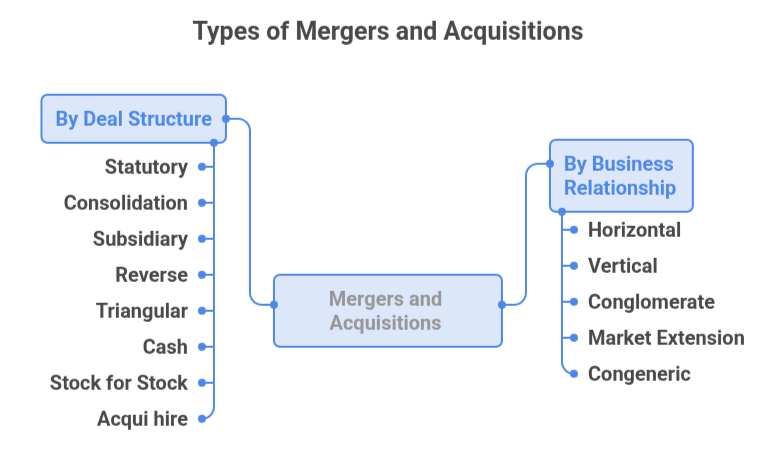
Most M&A deal type fall into two broad buckets:
- By business relationship – how the two companies relate to each other (competitors, supply chain partners, unrelated industries)
- By legal/deal structure – how the transaction is actually executed on paper
We’ve grouped the 13 merger and acquisition types below into two lenses: how the businesses relate to each other, and how the deal gets structured on paper.
13 Types based on how the companies relate:
This is the lens that shapes your positioning and your merger and amalgamation strategy of what the two businesses are actually doing for each other once the ink dries.
1. Horizontal Merger
A horizontal merger or acquisition happens when two businesses operating at the same stage of an industry combine.
Common objectives include :
- Increasing market share
- Expanding customer reach
- Achieving economies of scale
- Reducing overlapping costs
- Strengthening distribution
- Acquiring a competitor’s capabilities
The simplest example is:
Competitor + Competitor
The attraction is usually fairly obvious. The combined company may gain market share, enter new locations, add customers or achieve economies of scale.
The buyer needs to look closely at overlapping customers, locations, employees, operating costs, brands and technology. Competition concerns may also need to be assessed.
This is where proper merger due diligence becomes critical. The question is not just whether the target is profitable today. It is whether the expected benefits of combining the two businesses are realistic.
An Example of a horizontal merger is HDFC Bank’s 2023 merger with HDFC Ltd, a roughly $40B deal that folded India’s largest housing lender into its largest private bank. It’s about as textbook a scale play as Indian finance has seen.
Key risk: Antitrust scrutiny and culture clashes between two similarly sized organizations.
2. Vertical Merger
A vertical merger type connects businesses that operate at different points in the same supply chain.
Let’s say:
Manufacturer → Supplier
or
Manufacturer → Distributor
The objective may be to:
- Secure supply
- Improve margins
- Reduce dependency on third parties
- Improve quality control
- Control distribution
- Reduce supply-chain friction
- Gain access to specialised capabilities
The idea is to gain greater control over something that the business previously depended on another company to provide.
Vertical M&A can potentially improve supply-chain control, distribution, sourcing or customer access.
Tata Steel’s 2018 acquisition of Bhushan Steel is a good vertical acquisition example instead of negotiating raw steel capacity from outside, Tata simply bought a chunk of it.
Before pursuing such a deal, a buyer should ask:
Does owning another stage of the value chain genuinely improve the economics of the business?
Key risk: The catch is that you’re now running two genuinely different businesses a manufacturer and a supplier don’t operate the same way, and pretending they do slows everyone down.
3. Conglomerate Merger
Two companies in industries that have nothing to do with each other decide to combine anyway.
This kind of merger is a hedge, plain and simple, spreading revenue across business cycles so one bad quarter in one industry doesn’t sink the whole group.
Think of:
Business A: Manufacturing
Business B: Consumer Products
Potential reasons include:
- Diversifying revenue
- Entering a new industry
- Deploying excess capital
- Reducing dependence on one market
- Acquiring a new capability or brand
The motivation is usually diversification. A company may want to reduce its dependence on one industry, gain exposure to another market or deploy capital into a business with a different revenue and cash-flow profile.
Congeneric merger example of Tata Sons buying Air India in 2022 is a clean illustration: a group already in steel, salt, and software adding full-service aviation to the mix.
Key risk: The challenge is management attention. Buying a business in an unfamiliar sector means the acquirer also takes on a new operating environment, customer base, competitors and risks. Diversification is useful only when the acquiring group can actually manage what it buys.
4. Market Extension Merger
Same product, same business model, different geography the acquirer hasn’t cracked yet.
The basic strategy is:
Existing business + new market = faster expansion
Rather than spending years building a new distribution network, customer base and local presence, an acquirer can purchase an established business.
The buyer may gain:
- New geography
- Existing customers
- Local distribution
- Brand recognition
- Local management expertise
- Market-entry capabilities
Example: Walmart’s $16B purchase of Flipkart in 2018 gave a US retail giant an instant foothold in Indian e-commerce that would’ve taken years to build organically.
The deal gave Walmart a significant presence in India’s e-commerce market through an established local business.
Key risk: For business owners considering this kind of merger, the important question is whether the target genuinely provides market access that would be difficult or expensive to build independently.
5. Congeneric (Product Extension) Merger
The target sits in a related industry, shared customers or shared technology without being a direct competitor.
It’s mostly a cross-selling play: reach the same customer with a new product instead of chasing a new customer altogether.
The buyer may be looking for:
- Cross-selling opportunities
- Shared customers
- Complementary capabilities
- Distribution synergies
- Technology or IP
- Broader product offerings
Example: Google’s acquisition of Fitbit is a useful example. Google completed the acquisition in January 2021, bringing Fitbit’s established wearable-device business and user base into Google’s broader ecosystem
Key risk: The key question is whether those capabilities complement what the buyer already has. Buying a promising product is one thing; successfully connecting it to an existing ecosystem is another.
Types based on how the deal is executed:
This is the lens your lawyers and your M&A advisory team live in. It decides tax treatment, who’s liable for what, and how much paperwork you’re signing up for.
1. Statutory Merger (Absorption)
In a statutory merger, one company generally survives the legal combination while the other ceases to exist as a separate legal entity.
A simplified illustration is:
Company A + Company B → Company A
The surviving company takes on the applicable rights, obligations and assets according to the relevant legal framework.
Example: Vodafone India’s 2018 merger with Idea Cellular is exactly this: both original entities dissolved into the new Vodafone Idea.
It’s the quickest route to full integration, but there’s no walking it back if the combination doesn’t work out the way you planned.
2. Consolidation
A consolidation differs from a statutory merger because the combining businesses create a new entity.
The basic structure is:
Company A + Company B → Company C
Instead of one of the original companies surviving, a new company becomes the combined entity.
This distinction may sound technical, but transaction structure can have practical consequences for ownership, liabilities, approvals, taxation and post-deal operations.
Example: India’s 2020 public-sector bank consolidation, where Oriental Bank of Commerce and United Bank of India merged into a restructured Punjab National Bank, is a solid real-world case.
For any proposed transaction, these matters should be assessed with the relevant legal and financial advisors.
3. Subsidiary Merger
The acquired company keeps its own legal identity and runs as a subsidiary rather than getting folded in.
For example:
Parent Company → Subsidiary → Target
Tata Motors kept Jaguar Land Rover running as its own subsidiary after the 2008 acquisition of its own leadership, own operations and brand.
It protects the brand and keeps operations independent, which is exactly why it’s the go-to for cross-border or luxury acquisition type.
4. Reverse Merger
A reverse takeover can allow a private company to become publicly traded by combining with an existing public company or public vehicle.
A related structure is a Special Purpose Acquisition Company (SPAC).
In simplified terms:
Private Company + Public Vehicle → Public Company
Burger King took this route in 2012, merging with the listed shell Justice Holdings instead of running a traditional IPO process.
Cheaper and faster than an IPO, sure, but with far less market scrutiny along the way which is its own kind of risk. (If exit is the goal rather than a listing, our business exit services page walks through the other paths worth considering.)
5. Triangular Merger (Forward & Reverse)
A triangular merger type uses a subsidiary of the acquiring company to complete the transaction.
The structure can be simplified as:
Acquirer → Acquisition Subsidiary → Target
Forward triangular: The target merges into the acquirer’s subsidiary, which survives.
Reverse triangular: The acquirer’s subsidiary merges into the target, and the target survives as the subsidiary.
Instead of the parent company directly merging with the target, an acquisition subsidiary becomes part of the transaction structure.
This can offer transaction-structuring flexibility in certain jurisdictions.
For business owners, however, the important point is that a triangular merger describes the legal structure of the transaction, not necessarily its commercial objective.
Example: Disney’s 2006 acquisition of Pixar was built this way, Disney absorbed Pixar’s assets while keeping the legal exposure contained inside a merger subsidiary.
This is the default structure behind most large public-company deals, mostly for tax and liability reasons rather than anything strategic.
6. Cash Merger (Cash Acquisition)
The acquirer pays entirely in cash and the target’s shareholders exit completely, with no stake left in the combined company.
Microsoft’s $26.2B all-cash purchase of LinkedIn in 2016 is a straightforward example: LinkedIn shareholders got certainty, not a bet on Microsoft’s future stock price.
Clean and fast for everyone involved, but it locks up a lot of capital and gives the seller no share of whatever upside comes next.
7. Stock-for-Stock Merger
Instead of cash, target shareholders receive shares in the acquiring company, sometimes on top of a cash component.
Facebook’s roughly $19B purchase of WhatsApp in 2014 mixed cash with a large stock component, tying WhatsApp’s founders to Facebook’s long-term performance.
It keeps cash on the acquirer’s balance sheet, but it dilutes existing shareholders and hitches the seller’s outcome to the buyer’s share price.
8. Acqui-hire
The buyer wants the team, not the product this kind of acquisition type is really a hiring decision wearing an M&A wrapper.
A company might acquire a smaller startup because it wants its:
- Engineering team
- Product specialists
- Technical expertise
- Leadership talent
- Industry knowledge
That creates a different kind of due-diligence question.
What happens if the people the buyer wanted leave six months after the transaction?
Integration is usually the easy part here; the whole deal falls apart if the people you bought leave within a year.
Facebook’s 2010 acquisition of Drop.io is the textbook case: the product got shut down not long after, but founder Sam Lessin and his core team moved into senior roles at Facebook.
Quick Comparison: 13 Types of M&A at a Glance
| Type | Primary goal | Integration complexity |
| Horizontal | Market share & scale | High |
| Vertical | Supply-chain control | Medium |
| Conglomerate | Diversification | High |
| Market Extension | Geographic reach | Medium |
| Congeneric | Cross-selling | Medium |
| Statutory (Absorption) | Full integration | High |
| Consolidation | Neutral combination | High |
| Subsidiary | Preserve brand independence | Low-Medium |
| Reverse Merger | Fast public listing | Medium |
| Triangular | Liability containment | Medium |
| Cash Merger | Clean exit for seller | Low |
| Stock-for-Stock | Shared upside | Medium |
| Acqui-hire | Talent acquisition | Low |
Advantages and Disadvantages of M&A
Before picking a type, it’s worth being honest about what types of synergies in m&a actually delivers and what it costs because the upside is real but so is the downside, and Indian deals have their own flavour of both.
Advantages:
- Business Growth – Companies can expand their size, market share, and customer base quickly.
- Market Expansion – Company mergers can help a company enter new geographical markets or industries.
- Synergies – Combined companies may reduce costs or increase revenues through shared resources, technology, and expertise.
- Economies of Scale – Larger operations can reduce the average cost of production, purchasing, and administration.
- Access to Technology and Skills – An acquisition can provide access to new technology, intellectual property, talent, or specialized knowledge.
Disadvantages:
- Cultural clashes: Mismatched leadership styles and values are a leading cause of failed integrations.
- Overpaying: Deal pressure and optimistic projections can inflate valuation beyond real synergies.
- Financial & Operational Risks: Hidden liabilities, weak financial performance, customer concentration, compliance issues, or operational problems may emerge during or after the transaction.
- Management Distraction: M&A can require significant management attention, potentially diverting focus from day-to-day operations and existing growth priorities.
- High Transaction Costs: M&A involves costs related to valuation, due diligence, legal work, advisory, financing, documentation, and integration.
Business owners should also understand the common mistakes that can kill M&A deal in India before entering negotiations.
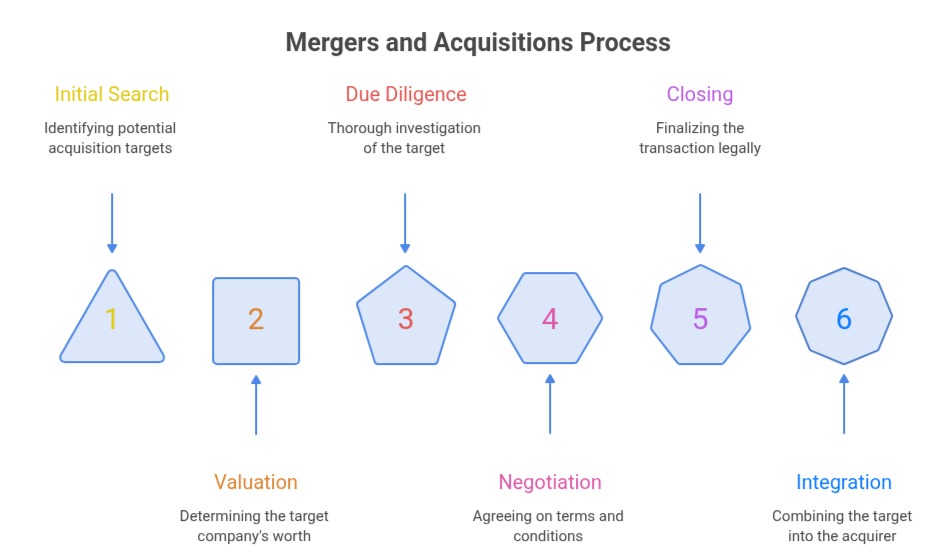
The M&A process, stage by stage
Whatever type you’re pursuing, a structured merger and acquisition process is what stands between a good deal and an expensive lesson. Sourcing, valuation, due diligence, negotiation, closing, and integration keep any of these 13 deal types from becoming a costly mistake. Rushing diligence to hit a closing date is one of the most common (and expensive) errors we see across deal types in merger and acquisition process.
What Should You Evaluate Before an M&A Deal?
Choosing the types of m&a transactions is only the beginning.
Before signing an M&A deal, consider these five areas.
1. Strategic Fit
Does the target actually help you achieve your growth objective?
If the answer is unclear, increasing revenue alone may not justify the acquisition.
2. Valuation
Does the target actually help you achieve your growth objective?
If the answer is unclear, increasing revenue alone may not justify the acquisition.
3. Deal Structure
Will the transaction involve an asset purchase, share acquisition, merger, partial acquisition, or another structure?
The answer can affect control, liabilities, financing and integration.
4. Integration
What happens on day one after the deal closes?
Management should have clarity on people, systems, customers, leadership, reporting and operations.
Purchase price is only one part of an M&A transaction.
Payment terms, warranties, indemnities, earn-outs, escrow, management continuity and other terms can significantly influence the final economics of the deal.
Successful M&A transaction also depends on how the deal progresses from initial evaluation to completion. Learn more about the M&A process.
Where Merger Due Diligence Fits Into All of This?
Whichever merger type you’re pursuing, merger due diligence is what separates a deal that creates value from one that destroys it. The specific diligence checklist changes by type:
- Horizontal deals need heavy antitrust and market-concentration review
- Vertical deals need supplier/customer contract and dependency analysis
- Conglomerate deals need standalone financial health checks, since there’s no operational overlap to fall back on
- Reverse mergers and SPACs need extra scrutiny on the shell entity’s liabilities and governance history
We put together a full business due diligence checklist for India if you want the granular version
India’s M&A Market in 2026: What Business Owners Should Know
The Indian M&A market has remained active in 2026, but the numbers show an important shift: deal activity is becoming more selective and strategic rather than simply larger in volume.
Grant Thornton Bharat’s Q1 2026 Dealtracker recorded 271 M&A deals worth US$6.9 billion. M&A volumes were the second-highest quarterly level historically, even though deal value declined because there were fewer large-ticket transactions.
The picture changed in Q2.
India recorded 240 M&A deals worth US$27.9 billion, the highest quarterly M&A value since Q2 2022. Five billion-dollar outbound transactions accounted for much of that value, with outbound deals contributing 84% of total M&A value. At the same time, domestic M&A remained volume-led, accounting for 64% of M&A deals.
By August 2026, Grant Thornton Bharat reported 85 M&A deals worth US$3.5 billion, a three-month high in deal volume. Domestic transactions accounted for 79% of M&A volume that month.
Deal volume and deal value can tell very different stories.
How Are M&A Deals Valued?
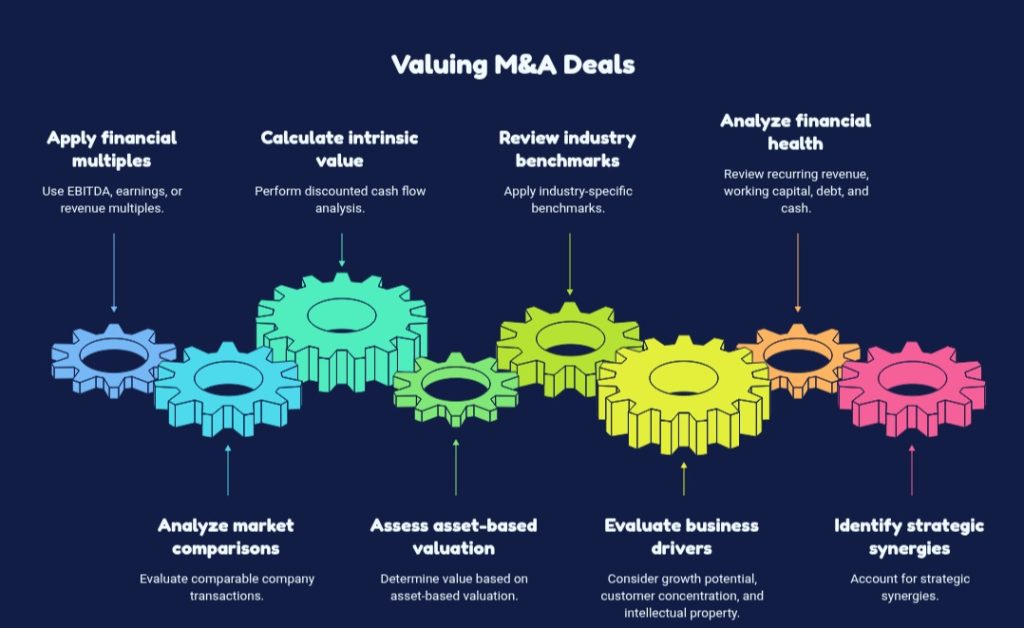
There is rarely one number that tells you what a business is worth.
Depending on the company and transaction, valuation may consider:
The buyer and seller may naturally arrive at different views of value.
The seller looks at the business’s future potential and the value they have created. The buyer also considers what it will cost to integrate the business and how much of the expected synergy can realistically be captured.
This is why valuation should be connected to the M&A strategy, not treated as a standalone number.
What Happens to Shareholders in a M&A Deal?
The impact depends on how the transaction is funded and structured.
Shareholders may receive:
- Cash
- Shares in the acquiring or combined company
- A combination of cash and shares
- Deferred consideration
- Earn-out payments, where applicable
In stock-based transactions, ownership percentages can change because new shares may be issued.
For a public-company transaction, the market may also react to the premium paid, expected synergies, financing requirements and perceived execution risk.
For private-company owners, the equivalent questions are often more practical:
How much cash do I receive at closing? What portion is deferred? What happens to my remaining stake? What obligations remain after the sale?
The headline purchase price is therefore only one part of the economics of an M&A deal.
Where Does M&A Advisory Fit In?
M&A transaction can become complicated quickly.
There may be promoters, buyers, investors, lawyers, accountants, tax advisors and regulatory authorities involved at different stages.
This is where M&A advisory can provide structured support.
An advisor can help with areas such as:
- Evaluating whether an M&A opportunity makes strategic sense
- Identifying potential acquisition or exit opportunities
- Business valuation
- Preparing transaction information
- Identifying suitable buyers or investors
- Preparing for due diligence
- Evaluating deal structures
- Negotiation support
- Coordinating different transaction stakeholders
- Supporting the transaction through closing
For an owner, the value is often less about simply finding a buyer and more about having someone who understands how the pieces of the transaction fit together.
If you are evaluating a merger, acquisition or business exit, you can explore IBGrid’s M&A and business exit advisory services to understand how the advisory process works.
For a broader explanation of the Indian M&A landscape, our guide on M&A in India and what business owners should know before signing a deal covers the transaction process, due diligence, deal terms and regulatory considerations in greater detail.
| Before you move further: get the M&A Playbook Everything above is the theory of deal types. Our free M&A Playbook is the execution layer: checklists, templates, and the questions to ask before you sign a term sheet. Get the M&A Playbook |
| Key takeaways: – 13 different types of merger and acquisition exist, split between business-relationship types (horizontal, vertical, conglomerate, market extension, congeneric) and deal-structure types (statutory, consolidation, subsidiary, reverse, triangular, cash, stock, acqui-hire). – The kind of deal decides the diligence checklist, the regulatory exposure, and the integration playbook. There’s no single M&A process that fits all thirteen. – Getting the classification right at the outset shapes everything downstream, from how you value the target to how integration actually goes. |
There is no single “M&A transaction.”
A competitor acquisition, a supplier acquisition, a market-entry acquisition and a talent-driven acquisition all kinds of mergers and acquisitions have completely different objectives. On top of that, the legal structure used to complete the transaction introduces another layer of complexity.
For business owners, understanding the types of mergers and acquisitions is therefore useful but identifying the right transaction starts with a more basic question:
What are you trying to achieve through the deal?
Once that is clear, the next steps are to assess valuation, conduct proper merger due diligence, choose an appropriate structure and prepare for the wider merger and acquisition process.
If you are considering an acquisition, merger, strategic investment or business exit, the earlier these questions are addressed, the more prepared you are likely to be when serious negotiations begin.
Let us help you with the right investment banking plan for your business needs.
FAQs
1. What are the main types of mergers and acquisitions?
Different types of m&a, broadly horizontal, vertical, conglomerate, market extension, and congeneric mergers are the kinds of merger that cover the business-relationship side. On the structural side, you’ve got statutory mergers, consolidations, subsidiary mergers, reverse mergers, triangular mergers, cash deals, stock deals, and acqui-hires thirteen in total, and most real deals combine one from each list.
2. What’s the difference between a merger and an acquisition?
A merger is two companies agreeing to become one, often a brand-new entity. An acquisition is one company buying and absorbing another, which usually stops existing as an independent business afterward. In everyday conversation, the two words get used interchangeably, but the legal and tax treatment can differ quite a bit.
3. Which type of M&A carries the highest regulatory risk?
Horizontal mergers, without much competition kind of merger. Buying a direct competitor removes a rival from the market, and that’s precisely what antitrust regulators are watching for.
4. Why is merger due diligence important?
Due diligence helps the parties identify financial, legal, tax, commercial, operational and other risks before completing the transaction. It can also influence valuation, deal terms and the final decision to proceed.
5. When should a business consider M&A advisory?
M&A advisory can be useful when a business is evaluating an acquisition, merger, partial sale, strategic investment or exit and needs support with valuation, transaction strategy, due diligence, buyer identification, negotiation or execution.
6. Do I need M&A advisory support for a smaller deal?
Probably, yes deal size doesn’t shrink the complexity as much as people assume. Valuation disagreements, diligence gaps, and integration missteps show up at every size of deal we’ve worked on. Good M&A advisory support tends to pay for itself by catching problems before signing, not after.
No matter which of these 13 kinds of mergers and acquisitions your deal falls into, it lives or dies on how well due diligence and integration are handled. Talk to our team before you sign anything, or start with the checklist.