
Not a textbook. Not a legal brief. This is what M&A looks like from the owner’s chair,- the deal structures, the regulatory gauntlet, the costs nobody warns you about, and the three mistakes that destroy value in Indian deals every year.
Most Business Owners Enter M&A Blind. Here Is What the Process Actually Looks Like.
| “After a decade of conversations with the practitioners who lead these transactions, one truth holds: what separates successful M&A from failed M&A is almost never the financial model. It’s everything that happens before and after it.” By Kison Patel, Founder & CEO (10+ years, 400+ practitioner interviews), M&A Science / DealRoom Source:M&A Science |
That single insight explains why 70-90% of M&A deals globally fail to achieve their intended objectives. The spreadsheet looks perfect. The strategy makes sense. And then reality hits,- cultural clashes, regulatory delays, undisclosed liabilities, integration chaos,- and crores of value evaporate.
If you are a business owner in India thinking about selling your company, acquiring a competitor, or merging with a partner, this guide is your reality check. Not the theory. The practice. What actually happens, how long it actually takes, what it actually costs, and where Indian deals actually go wrong.
4 Deal Structures,- And Why Your Tax Bill Depends Entirely on Which One You Pick
Indian law does not use the word ‘merger.’ It uses ‘amalgamation’, and the distinction matters, because only a deal that qualifies as an amalgamation under Section 2(1B) of the Income Tax Act gets tax-neutral treatment. Every other structure has a different tax bill.
Choose the wrong structure and you can lose 15-30% of your deal value in avoidable taxes.
| “The tax regime when it comes to acquisitions is particularly difficult to navigate in India and can trip you up unexpectedly. There are many different ways to structure transactions.” By Lightspeed Venture Partners India, Based on interviews with Indian founders across Rs.25,000+ crore in aggregate exits, Lightspeed India Source: Lightspeed India Blog |
| Structure | What Happens to You | Tax Impact | Best When |
| Share Purchase | Buyer buys your shares. You receive cash (or stock). Company continues as-is with all assets and liabilities. | LTCG at 12.5% if shares held >24 months (unlisted). No indexation benefit available. STCG at your applicable income tax slab rate (up to 30% + surcharge + cess) if shares held ≤24 months. Stamp duty varies by state and mode of transfer (0.015% for demat; higher for off-market/physical transfers). | Clean exit. Buyer wants the whole company. Most common structure for Indian private company M&A. |
| Slump Sale (S.50B) | You sell an entire business unit as a going concern for a lump sum. No individual asset values assigned. | LTCG at 12.5% if undertaking held >36 months. No indexation benefit available. Gains = lump sum minus net worth of the undertaking (total assets minus total liabilities as per books). STCG at your applicable slab rate if held ≤36 months. Stamp duty varies by state (3–8% in some states, as it is treated as a conveyance). GST exempt if transferred as a going concern; GST may apply if not a going concern. | Selling a division while keeping the rest. Carving out a business unit. |
| Scheme of Arrangement (S.230-232) | NCLT-approved merger or demerger. Both companies restructured per the court-sanctioned scheme. | Can be tax-neutral if it qualifies as amalgamation under S.2(1B). S.47 exempts capital gains. Losses and unabsorbed depreciation carry forward under S.72A for up to 8 years. If it does not qualify under S.2(1B), LTCG at 12.5% or STCG at slab rate applies. | Large, complex mergers. Demergers. Situations needing shareholder and creditor approval. |
| Asset Purchase | Buyer cherry-picks specific assets,- equipment, IP, contracts, customer lists. You keep the company shell. | Each asset taxed separately. Depreciable assets: S.50 (difference between sale price and written-down value taxed as STCG at slab rate). Capital assets: LTCG at 12.5% or STCG at slab rate depending on holding period. Inventory: taxed as business income at slab rate. GST at 18% applicable on each asset individually. | Buyer wants specific assets but not your liabilities. You retain the entity for other purposes. |
| WHAT THIS MEANS IN RUPEES On a Rs.25 crore share sale of an unlisted company held for 3 years: LTCG at 12.5% = Rs.3.12 crore in tax (assuming entire Rs.25 crore is gain with zero cost of acquisition). No indexation benefit available to reduce this. The same deal structured as an asset purchase with depreciable machinery and inventory could trigger Rs.5–7 crore in combined tax and GST. Depreciable assets are always taxed as STCG at slab rate (up to 30%) regardless of holding period, and GST at 18% applies on each asset separately. That Rs.2-4 crore difference is the cost of not getting independent tax advice before agreeing to a structure. |
The structure determines your tax. But the process determines whether the deal actually closes.
The 8 Stages of an M&A Deal, And How Long Each One Actually Takes in India
Every M&A deal follows the same arc. Here is what each stage looks like from the owner’s chair, with realistic Indian timelines:
Stage 1: Preparation (2-6 months before going to market)
Clean your financials, get valued, reduce owner dependency, resolve litigation, formalise contracts. This stage is invisible to the outside world but determines 80% of your deal outcome. Skip it and the buyer’s DD team will find everything you didn’t fix,- and reprice accordingly.
Stage 2: Advisor Engagement & Buyer Identification (1-3 months)
Engage an M&A advisor or investment banker. They prepare your Confidential Information Memorandum (CIM) and build a target list of 20-50 potential acquirers. For deals above Rs.10 crore, a structured auction with multiple buyers typically yields 15-25% higher prices than a bilateral negotiation.
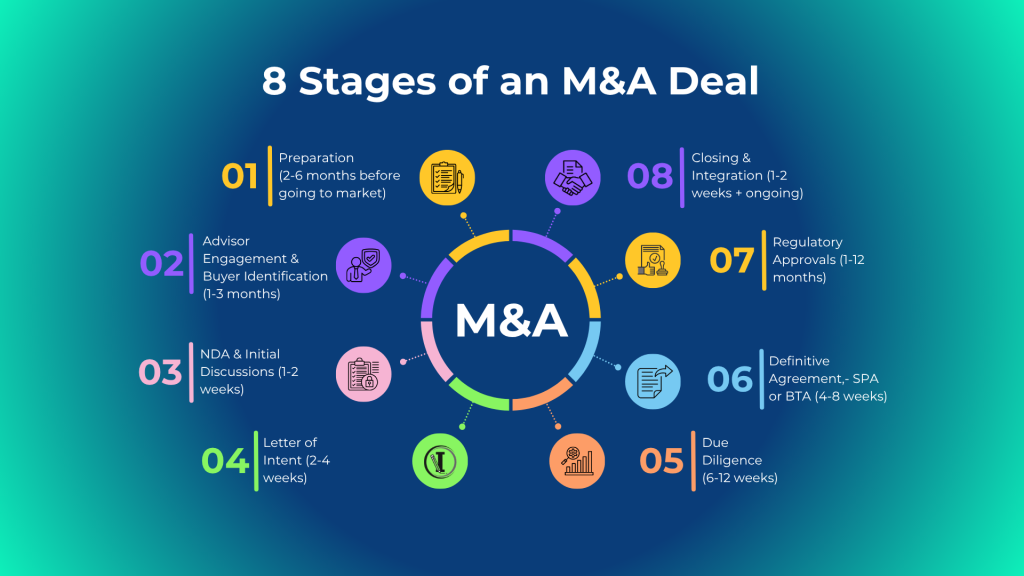
Stage 3: NDA & Initial Discussions (1-2 weeks)
Before sharing any financial information, both parties sign a Non-Disclosure Agreement. Never share financials without one,- even with ‘trusted’ parties. First meetings happen. The buyer assesses strategic fit. You assess whether this is someone you want to sell your life’s work to.
Stage 4: Letter of Intent (2-4 weeks)
The buyer submits a non-binding offer outlining price, structure, key conditions, and timeline. The LOI is typically non-binding on price but binding on exclusivity,- meaning you cannot talk to other buyers for 60-90 days. Negotiate the exclusivity period. It is the buyer’s strongest leverage.
Stage 5: Due Diligence (6-12 weeks)
The buyer’s lawyers, CAs, and consultants descend on your business. They examine every financial statement, every contract, every tax filing, every pending case. This is where deals slow down, surprises emerge, and prices get renegotiated. More on this in the next section.
Stage 6: Definitive Agreement,- SPA or BTA (4-8 weeks)
Lawyers draft the Share Purchase Agreement or Business Transfer Agreement. This is the binding contract containing price, escrow, earn-out, non-compete, representations, warranties, indemnities, and closing conditions. Negotiating the SPA is often harder than negotiating the price,- because this is where risk allocation happens.
Stage 7: Regulatory Approvals (1-12 months)
Depending on your deal, you may need NCLT, CCI, SEBI, or RBI approval. This is the stage that Indian business owners underestimate most. Details in the next section.
Stage 8: Closing & Integration (1-2 weeks + ongoing)
Shares or assets transfer. Money hits your account,- minus escrow holdback. Regulatory filings are completed. And then the real work begins: integration. The stage where most value is created or destroyed.
The Regulatory Gauntlet: Which Approvals You Need and How Long They Take
This is where Indian M&A gets slow. And where most owners lose patience,- or lose deals.
| Authority | When It Applies | Timeline | Filing Cost |
| NCLT | Schemes of arrangement (merger, demerger, amalgamation) under S.230-232. Fast-track (S.233) for small companies or holding-subsidiary mergers. | Full route: 6-12 months. Fast-track: 3-6 months. | Court fees + legal (Rs.5-20 lakh) |
| CCI | Combinations exceeding thresholds: combined assets >Rs.2,500 crore OR turnover >Rs.7,500 crore (India). NEW (2024): Deal value >Rs.2,000 crore also triggers filing. | Green channel: automatic. Phase I: 30 working days. Phase II: 150 + 60 days. | Rs.20 lakh (Form I) or Rs.65 lakh (Form II) |
| SEBI | Listed company M&A: open offer (Takeover Code), preferential issue (ICDR). Acquiring 25% or more triggers mandatory open offer of minimum 26%. | Open offer: 30-60 days. Overall: 2-4 months. | Variable,- open offer cost can be substantial |
| RBI / FEMA | Cross-border deals: FDI pricing for inbound, ODI for outbound, resident-NR share transfers. Press Note 3 for land-border countries. | Automatic route: 2-8 weeks. Government route: 3-6 months. | No filing fee but significant compliance costs |
| MCA / ROC | Post-merger filings, director changes, updated MOA/AOA, share allotments. | 2-4 weeks. | Nominal (Rs.500-5,000) |
| 2024 UPDATE: CCI DEAL-VALUE THRESHOLD The Competition Commission’s new 2024 Combination Regulations introduced a deal-value threshold of Rs.2,000 crore. This means even acquisitions of small companies can trigger CCI filing if the total transaction value,- including deferred payments, earn-outs, and related arrangements,- exceeds this threshold. Factor CCI timelines into every deal negotiation. Phase II reviews can add 6+ months to your closing date. |
Due Diligence: The Stage Where Indian Deals Go to Die
Buyers will examine seven areas of your business: financial, legal, tax, regulatory, operational, HR, and ESG. The India-specific traps that surface most often:
- GST compliance gaps: Input credit mismatches, incorrect classifications, and unfiled returns create contingent liabilities that buyers price into the deal,- or walk away from entirely.
- Related-party transactions: Transactions with promoter-owned entities at non-arm’s-length prices are the single biggest red flag in Indian SME deals. If your company rents property from your family trust at below-market rates, expect this to be flagged and adjusted.
- Undisclosed litigation: Legal notices sitting in a drawer that the promoter ‘forgot about.’ Every open case is a line-item discount on your valuation.
- Verbal contracts: Major customer relationships on handshake agreements. Buyers see unenforceable revenue,- and discount accordingly.
- Employee misclassification: Workers on the books as ‘consultants’ without proper contracts. Creates employer liability risk for PF, ESI, gratuity, and labour law compliance.
| REAL INDIAN CASE STUDIES Daiichi-Ranbaxy (2008): Daiichi acquired Ranbaxy for $4.6 billion. Post-deal, US FDA and DOJ investigations revealed fabricated drug testing data that the sellers had concealed. Ranbaxy was fined $500 million in the FDA and DOJ investigation for knowingly selling substandard drugs. Chemistry World An arbitration court in Singapore ordered former shareholders to pay $525 million to Daiichi Sankyo ACS C&EN for concealment and misrepresentation. Lesson: DD must go beyond what the seller volunteers. Airtel-Zain Africa (2010): Bharti Airtel acquired Zain’s African operations for $10.7 billion. Analysts noted that networks had remained underinvested for years tele.net and Airtel would need substantial funds to expand them. Five years later the acquisition was not profitable, and Airtel sold operations in 4 African countries to Orange SA for around $900 million. Scribd Lesson: operational DD on the actual condition of assets is non-negotiable. |
Due diligence reveals the risks. But there is another number most owners never think to ask about: what the deal itself will cost them.
What Nobody Tells You: The Actual Cost of Doing an M&A Deal in India
The deal has a price. But the deal also has a cost,- advisory fees, legal fees, regulatory filings, stamp duty, and valuation. Here is what to budget:
- M&A advisor / investment banker: 1-3% of deal value as success fee. On a Rs.25 crore deal, that is Rs.25-75 lakh. Some charge a monthly retainer (Rs.1-3 lakh) plus a reduced success fee.
- Transaction lawyer: Rs.10-50 lakh for a mid-market deal. Complex cross-border deals can exceed Rs.1 crore.
- Tax advisor (CA with M&A experience): Rs.2-10 lakh for structuring advice and tax modelling.
- Valuation report: Rs.1.5-5 lakh for a DCF-based report from an IBBI-Registered Valuer or SEBI Merchant Banker.
- CCI filing fee: Rs.30 lakh (Form I) or Rs.90 lakh (Form II). Only if thresholds are triggered.
- Stamp duty: Varies dramatically by state and structure. 0.1% on share transfers in Maharashtra. 3-8% on slump sale in some states. Always model this before choosing your structure.
- Due diligence (if you are the buyer): Rs.5-30 lakh for comprehensive financial, legal, and tax DD by a reputable firm.
Total cost for a mid-market Indian M&A deal (Rs.10-50 crore range): Rs.30-80 lakh in transaction costs. On a Rs.100+ crore deal, expect Rs.1-3 crore. These are not optional expenses,- they are the cost of getting the deal right.
The Three Terms That Shrink Your Headline Number
The price you agree on is not the price you take home.
Earn-out (15-30% of deal value):
Money paid only if the business hits post-deal targets. Inflated your projections during negotiation? You just wrote yourself an IOU you cannot cash. Negotiate targets that are within your control,- not dependent on the buyer’s integration decisions.
Escrow (10-20%, held 12-24 months):
Parked in a third-party account to cover liabilities that surface after closing. The cleaner your business before the deal, the smaller this holdback. A well-prepared seller with audited financials and disclosed liabilities can negotiate escrow down to 5-10%.
Non-compete (2-4 years):
Enforceable in India for post-sale agreements (unlike employment non-competes, which are void under S.27 of the Indian Contract Act). Negotiate the scope narrowly: specific industry, limited geography, reasonable duration.
| “Understand what is consideration given to stockholders versus what is given as retention or earn-out packages. Be particularly aware of liquidation preferences.“ By Lightspeed Venture Partners India, Based on interviews with Indian founders across Rs.25,000+ crore in exits, Lightspeed India Source: Lightspeed India Blog |
After the Deal: Where 70-90% of Mergers Destroy the Value They Promised
| “Seasoned CFOs know the real work begins after closing. The majority of mergers fail to achieve their intended synergies, often because integration is underestimated.” By SuperCFO India, CFO Advisory Practice, SuperCFO Source: SuperCFO.com |
The deal closes. The celebration lasts a day. And then integration begins,- the stage that determines whether your transaction created value or destroyed it.
If you are the seller staying on with an earn-out, here is what the first 100 days look like: communicate with your employees immediately,- rumours are always worse than reality. Protect your key people with a retention plan agreed before closing. Clarify decision rights with the buyer on Day 1,- who has authority on hiring, spending, product decisions? Track synergy delivery monthly with specific metrics, not vague targets. And manage cultural integration deliberately,- if the buyer runs a corporate process and you ran an entrepreneurial shop, expect friction. Plan for it.
If you are the buyer, the biggest mistake is assuming the deal is done at closing. Integration is where cost synergies are captured, where revenue synergies materialise (or don’t), and where the people you just paid crores to acquire decide whether to stay or leave. Budget 5-10% of the deal value for integration costs. Appoint a dedicated integration lead. And move fast,- delayed decisions compound into delayed value.
The 5 Questions Every Business Owner Asks Before Their First Deal
1. How long does an M&A deal take in India?
Simple share purchase (private, no CCI): 4-6 months. Slump sale with filings: 5-8 months. NCLT scheme: 9-18 months. Cross-border with RBI + CCI: 8-14 months. Add 12 months of preparation before the clock starts. If you want to be done in 2 years, begin today.
2. Do I need an investment banker or M&A advisor?
For deals above Rs.10 crore: strongly recommended. A structured auction with multiple buyers yields significantly higher prices than bilateral negotiation, competitive tension is the seller’s strongest tool. The 1-3% advisory fee pays for itself. Below Rs.10 crore: a CA with M&A closing experience can work, but they must still run a competitive process.
3. What happens to my employees after the deal?
Share purchase: employees stay with the company, nothing changes legally. Slump sale: employees transfer but the buyer must honor PF, ESI, and gratuity. Scheme of arrangement: automatic transfer. Always negotiate an employee protection clause. How your people are treated in the exit reflects who you are.
4. Can I sell only part of my business?
Yes. A slump sale lets you sell one undertaking while keeping the rest. A demerger via NCLT splits your company before you sell one half. A PE investment gives you partial liquidity without a full exit. Each has different tax and regulatory consequences — match the structure to your goal.
5. What if the deal falls apart during due diligence?
It happens in a significant number of mid-market deals. Protect yourself: limit LOI exclusivity to 60-90 days, negotiate a break-up fee clause, and never stop running the business at full intensity during the sale process. Revenue dips during DD are one of the most common deal-killers.
| CONSIDERING AN M&A TRANSACTION? Whether you are selling, acquiring, or merging,- the earlier you start with the right advice, the better your outcome. Book a free 30-minute consultation. We will assess your situation, identify the regulatory requirements, and map out a realistic timeline and cost estimate. No pitch. No obligation. Just clarity. Email: [email protected] | Phone: 8000 422 133 |
2 Replies to “M&A in India: What Business Owners Must Know Before Signing a Deal”