

10 min read | April 2026 | For business owners, founders & SME promoters
You built this business with years of your life. The business exit should not be an afterthought. This guide walks you through the 5 exit routes, the 12-month preparation timeline, the tax reality, and the emotional truth that nobody warns you about,- all specific to India in 2026.
You Will Exit Your Business. The Only Question Is How.
Here is a number that should unsettle you.
| “The circle of founders who have exited businesses in India remains small,- likely not more than 100-150 founders with any type of material liquidity event.” – Lightspeed Venture Partners India, Based on interviews with Indian founders across Rs.25,000+ crore in aggregate exits, Lightspeed India Source: Lightspeed India Blog |
One hundred and fifty founders. In a country with over 209,000+ startups and millions of SMEs. That means almost every business owner you know,- including, very likely, you,- will face this moment without a playbook.
Some will get a knock on the door from a buyer and scramble to respond. Some will burn out and sell at a discount because they need out. Some will hand the business to a family member who does not want it. And some,- the ones who planned,- will walk away on their terms, with the number they wanted, into a life they designed.
This guide is for the last group.
5 Ways Out, And What Each One Actually Means for Your Bank Account
Not every exit is a sale. Not every sale is a clean break. Here are the five routes available to Indian business owners, mapped against the only four things that matter: what you receive, what you retain, how long it takes, and what the government takes from you.
| Exit Route | What Happens | Your Payout | Timeline | Tax Treatment |
| Strategic Sale | A buyer,- competitor, PE firm, or corporate,- acquires your company outright | Highest payout. Lump sum + possible earn-out. Full or partial exit. | 4-18 months | Share sale: LTCG 12.5% if held >24 months (no indexation). STCG at slab rate if held ≤24 months. Slump sale: LTCG 12.5% on lump sum minus net worth if held >36 months. Scheme: tax-neutral if S.2(1B) met, otherwise normal rates apply. |
| PE / VC Buyout | A private equity firm buys a majority or significant minority stake | Partial liquidity now. You stay, grow, and exit again later at a higher number. | 3-9 months | Share sale: LTCG 12.5% if held >24 months (no indexation). STCG at slab rate if held ≤24 months. Foreign PE may use DTAA for lower rates. |
| Management Buyout | Your own team buys you out,- funded by cash flow, debt, or PE backing | Slower payout, often in installments. Culture survives. | 6-12 months | Share or slump sale. Installments taxed as received. |
| IPO / SME IPO | You sell shares to the public via BSE SME or NSE Emerge | Partial exit. Promoter lock-in: 3 years for SME IPO. | 12-24 months (prep + listing) | Listed LTCG at 12.5% (>12 months). STT applies. |
| Family Succession | Transfer to next generation,- gift, sale, or trust | May be zero cash (gift) or structured buyout. Legacy lives. | 12-36 months | Gift: no tax for recipient. Sale: capital gains. Trust: specialist territory. |
| “Don’t be in a position where you need to sell. This dramatically changes who wins the negotiation and by how much. Protect your ability to get what you deserve,- and to even walk away.” – Kevin Dykes, Founder (5 acquisitions, 1 successful exit), Exit3x Source: Medium |
Whichever route you choose, the quality of your exit depends almost entirely on what you do in the 12 months before it begins.
The 12-Month Countdown: What to Fix Before a Buyer Sees Your Business
| “The best time to prepare for an exit is when you don’t need one. Founders who build transferable businesses early can act on opportunity. Those who wait are forced into unfavorable terms.” By Brian Franco, Serial Entrepreneur, Entrepreneur.com Source:Entrepreneur.com (March 2026) |
Months 12-9: Face the Mirror
Get a formal, independent valuation. Not to set a sale price,- but to see the gap between what you think the business is worth and what a buyer will actually pay. This is where the first shock hits. Owners who skip this step walk into negotiations blind, and blind sellers get taken.
While you are processing that number, start cleaning the house. Get 3-5 years of audited financials in order. Strip out personal expenses running through the company. Normalise related-party transactions that a buyer’s CA will immediately flag. Resolve pending litigation- every open case is a line-item discount on your valuation. Update your MCA filings, GST returns, and TDS records. Buyers check everything. What they find in these first documents sets the tone for the entire negotiation.
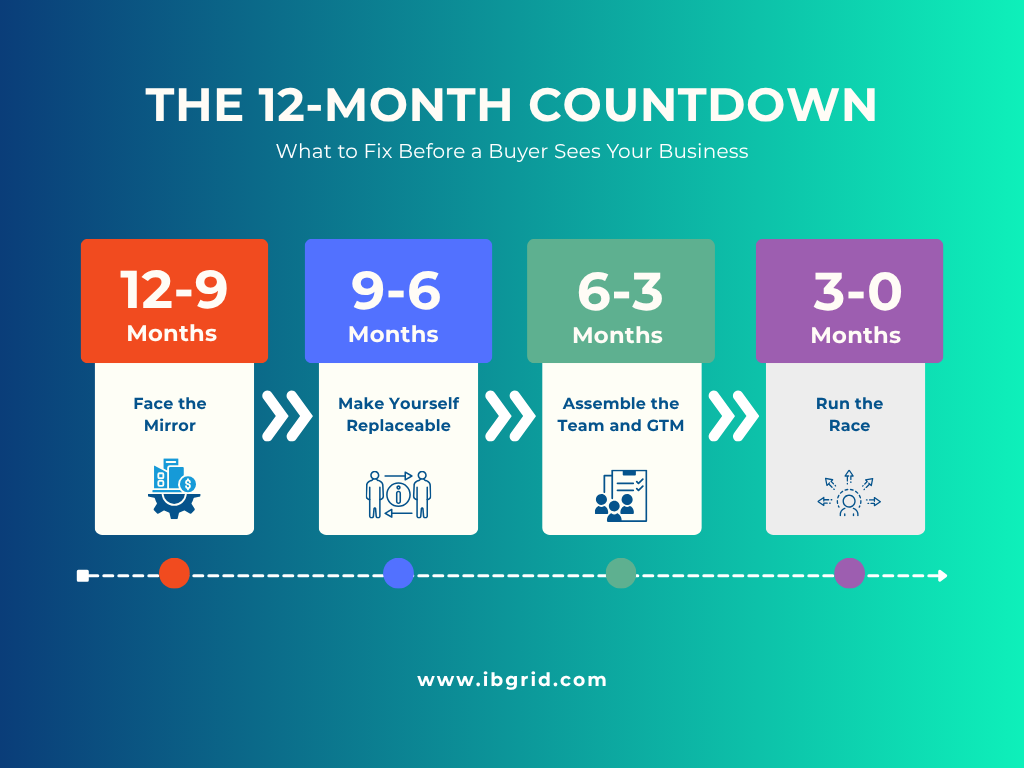
Months 9-6: Make Yourself Replaceable
This is the single most valuable thing you can do before selling.
If clients call your mobile, if you approve every purchase order, if the business stops when you take a two-week holiday,- a buyer sees concentrated risk. And concentrated risk means a lower multiple, a larger escrow, and a longer earn-out that ties you to the business you are trying to leave.
Build a management layer. Delegate the client relationships that live in your head. Systemise operations so the business runs on process, not on you. Formalise the contracts that are currently handshake deals. Diversify your customer base,- if one client accounts for more than 20% of revenue, expect a discount. And wherever you can, convert project-based revenue into retainers, AMCs, or subscriptions. Recurring revenue commands 2-3x higher multiples. That conversion alone can add crores to your exit price.
Months 6-3: Assemble the Team and Go to Market
Engage an M&A advisor or investment banker. For deals above Rs.10 crore, a structured auction with multiple interested buyers typically yields 15-25% higher prices than a one-on-one negotiation. Your advisor prepares the Confidential Information Memorandum,- the document that tells your company’s story to buyers,- and builds a target list of 20-50 potential acquirers.
Simultaneously, assemble the rest of your deal team: a transaction lawyer, a tax advisor (a CA who has actually closed M&A deals, not just filed returns), and your existing auditor. These four need to work as a unit. When they do not talk to each other, you lose time, you lose money, and you lose deal certainty.
Months 3-0: Run the Race
Your advisor approaches buyers. NDAs go out. The CIM is shared. Offers come in. You select the strongest, grant exclusivity for 60-90 days, and the buyer’s team descends for due diligence.
Here is where most deals die.
Research shows that 50-60% of mid-market deals collapse after the Letter of Intent is signed,- usually because the buyer uncovers problems the seller did not disclose, or because the seller takes their foot off the gas and revenue dips during the sale process. Keep running the business at full intensity. The moment you mentally check out, the buyer renegotiates down.
After DD, lawyers draft the definitive agreement. You negotiate the final terms,- price, escrow, earn-out, non-compete, representations and warranties. Regulatory approvals are obtained. Then you close, the money transfers, and the next chapter begins.
| “If you don’t decide what you want from an exit long before you decide you’re done with your business, you won’t walk away with what it’s worth. Avoid earn-outs. And when it comes to management buyouts, never accept an exit in installments.” By Jean Moncrieff, Serial Founder & Exit Advisor, JeanMoncrieff.com Source: JeanMoncrieff.com |
How Long It Actually Takes (Not How Long You Want It to Take)
Every owner asks this question, and every owner underestimates the answer. Here are the real numbers for India:
| INDIA-SPECIFIC DEAL TIMELINES (FROM LOI TO CLOSING) Share purchase (private, no CCI trigger): 4-6 months Slump sale with regulatory filings: 5-8 months Scheme of arrangement via NCLT: 9-18 months (full route). 3-6 months (fast-track S.233) Cross-border with RBI + CCI: 8-14 months SME IPO (preparation to listing): 12-18 months Add 3-5 months if CCI Phase II review is triggered under the 2024 Combination Regulations (Rs.2,000 crore deal-value threshold applies only if the target has substantial business operations in India). Add 2–4 months if SEBI open offer applies. |
These timelines start after the 12-month preparation period above. If you want to be fully exited within 2 years, the clock starts today,- not when a buyer appears.
What the Government Takes from Your Exit (And How to Keep More)
| “Without professional planning, it is entirely possible to lose 30-50% of sale proceeds to taxes. The difference between a well-structured and a poorly structured exit can be measured in crores for even mid-sized businesses.” By MyFinanceProcess, Exit Planning Advisory, MyFinanceProcess Source:MyFinanceProcess.com |
On a Rs.30 crore deal, the difference between the right structure and the wrong one is Rs.4-9 crore in tax. That is not a rounding error. That is a flat in Bandra or three years of your post-exit life. Here is what you need to know:
- Share sale: LTCG at 12.5% if held more than 24 months (unlisted). No indexation benefit available. STCG at your applicable slab rate (up to 30% + surcharge + cess) if held 24 months or less. Selling 1 month too early can nearly triple your rate from 12.5% to 30%. Timing is not a detail, it is a decision worth crores.
- Slump sale (S.50B): Entire undertaking is one capital asset. LTCG at 12.5% if held more than 36 months. No indexation. Gains = lump sum minus net worth of the undertaking. STCG at slab rate if held 36 months or less. Stamp duty varies by state, Maharashtra charges 0.1% on demat share transfers, but some states charge 3–5% on slump sales as they are treated as conveyance.
- Scheme of arrangement: Can be completely tax-neutral if it qualifies as amalgamation under S.2(1B). Capital gains exempt under S.47. Losses and unabsorbed depreciation carry forward under S.72A for up to 8 years. But the conditions are strict, 75%+ shareholders must continue, all assets and liabilities must transfer, and the business must continue. Miss one condition and the entire benefit collapses, normal tax rates apply as if it were an ordinary transaction.
- GST trap: Individual asset sales attract 18%. But a transfer of going concern as a whole is exempt under Notification 12/2017. One word in the agreement,- ‘going concern’ vs ‘assets’,- can swing your GST bill by crores.
- Earn-out taxation: Deferred payments are taxed in the year received. Whether they are capital gains or business income depends on how the agreement is drafted. Get this wrong and you pay tax at slab rates instead of 12.5%.
| THE NON-NEGOTIABLE RULE Have your CA model post-tax proceeds under at least two deal structures before you agree to anything. The buyer’s advisor will propose the structure that is optimal for the buyer. Your job is to know what is optimal for you. Your tax advisor must be in the room from Day 1,- not brought in after the LOI is already signed. |
The Three Terms That Shrink Your Headline Number by 20-40%
The price you agree on is not the price you take home.
Earn-out (15-30% of deal value):
Money you receive only if the business hits targets,- revenue, EBITDA, customer retention,- in the 1-3 years after closing. Miss the targets, lose the money. The trap: earn-out targets are often set based on your projections during negotiation. If you inflated your numbers to get a higher price, you just wrote yourself an IOU you cannot cash.
Escrow (10-20%, held 12-24 months):
Money parked in a third-party account to cover liabilities that surface after closing. Tax demands you forgot about. A lawsuit you did not disclose. A GST notice you did not know existed. Whatever is left gets released to you after the escrow period. The cleaner your house before the deal, the smaller this holdback.
Non-compete (2-4 years):
You agree not to compete in a defined industry and geography. In India, unlike employment non-competes (void under S.27, Indian Contract Act), post-sale non-competes are enforceable. Negotiate the scope narrowly. A nationwide, 4-year, all-industry non-compete is a cage. A state-specific, 2-year, single-sector restriction is reasonable.
| “Understand what is consideration given to stockholders versus what is given as retention or earn-out packages. Be particularly aware of liquidation preferences and map out in advance what will happen.” – Lightspeed Venture Partners India, Based on interviews with Indian founders across Rs.25,000+ crore in exits, Lightspeed India Source: Lightspeed India Blog |
Where to Find a Buyer (Ranked by What Gets You the Best Price)
M&A advisor / investment banker:
Best for deals above Rs.10 crore. They run structured auctions, create competitive tension between 3-5 serious buyers, and push pricing higher than any bilateral conversation. Fees: 1-3% success fee on deal value. Worth every rupee.
Direct approach to strategic buyers:
Your competitors, suppliers, or customers may be natural acquirers. Approach through intermediaries with NDAs. Never reveal you are selling before you are ready,- rumours destroy employee morale and customer confidence.
PE / VC networks:
If you want partial liquidity before a full exit, PE firms actively seek profitable Indian SMEs. Warm introductions through your CA, banker, or industry association work best.
Online platforms:
IndiaBizForSale, BizBuySell India, and similar platforms work for smaller deals in the Rs.50 lakh to Rs.1000+ crore range. Lower fees, but also lower buyer quality and less competitive tension.
Professional network:
CAs, lawyers, and industry associations are how many Indian mid-market deals start. Relationship-driven, but typically produces a single buyer,- which means less leverage for you.
You have found the buyer. You have negotiated the price. The money has hit your account. Now comes the part nobody prepares you for.
What Nobody Tells You About the Day After You Sell
| “I sold my business for $22M, but it was as devastating as putting my baby up for adoption. So lonely without guidance.” By Derek Sivers, Founder, CD Baby (sold for $22 million), CD Baby Source: Exit Strategy Book |
You celebrate. Friends congratulate you. The money lands. And then a strange emptiness arrives that you did not expect and cannot explain to anyone who has not been through it.
You built this thing from nothing. Your identity was fused with it. Clients knew your name. Employees looked to you. Every morning had a purpose. Now your calendar is empty, your phone is quiet, and the business you poured a decade into belongs to someone else.
This is a not weakness. This is the reality of every founder’s exit.
If you are staying on with an earn-out, it gets harder, not easier. You were a founder who made decisions in minutes. Now you are an employee who submits requests for approval. Your authority shrinks.
Your best people are anxious. The culture shifts. Most earn-out failures are not financial,- they are emotional. The founder disengages because they no longer feel ownership over something they used to own.
Plan for this before you sign. Negotiate your role, authority, and reporting line in the definitive agreement. Tell your team the truth before the announcement,- rumours are always worse than reality. And have a personal plan for what comes after: starting something new, advising other founders, investing, travelling, or simply resting.
The founders who exit well are the ones who planned their personal transition with the same discipline they planned the financial one.
The 5 Questions Every Owner Asks Before Signing
Do I need an M&A advisor, or can my CA handle this?
For deals above Rs.10 crore: hire an advisor. A structured process with multiple buyers creates competitive tension that a bilateral CA-led deal cannot. The 15-25% price uplift from a competitive auction easily covers the 1-3% advisory fee. Below Rs.10 crore, a CA with actual M&A closing experience,- not just filing experience,- can work, but they must still run a competitive process.
What if the deal falls apart after months of work?
It happens. Protect yourself by limiting LOI exclusivity to 60-90 days, insisting on a break-up fee clause (typically 1-2% of deal value), and never stopping business operations during the sale process. The most common deal-killers: undisclosed liabilities surfacing in DD, revenue declining because the owner mentally checked out, and valuation gaps that were papered over in the LOI but could not survive scrutiny.
Can I sell just a part of my business?
Yes. A slump sale lets you sell one business undertaking while keeping the rest. A demerger via NCLT splits your company into two before you sell one half. A PE investment gives you partial liquidity without a full exit. Each has different tax, regulatory, and operational implications,- choose based on your goal, not just the first option that appears.
What happens to my employees?
In a share purchase: nothing changes legally,- employees stay with the company. In a slump sale: employees transfer, but the buyer must honour existing PF, ESI, and gratuity obligations. In a scheme: automatic transfer. Regardless of structure, negotiate an employee protection clause in the agreement. Your people built this business alongside you. How they are treated in the exit reflects who you are.
When is the best time to sell?
When you do not need to. When revenue is growing, margins are healthy, and you have options. Selling from strength gives you leverage. Selling from exhaustion gives the buyer leverage. The best exits are planned 2-3 years before they happen, by owners who built businesses designed to run without them.
| THINKING ABOUT YOUR EXIT? You do not need to have all the answers today. But you do need to start asking the right questions,- about your timeline, your readiness, and the gap between where your business is and where it needs to be. Book a free 30-minute consultation. We will assess your situation, identify what needs to be fixed, and give you a clear roadmap. No pitch. No obligation. Just clarity. Email: [email protected] | Phone: 8000 422 133 |
One Reply to “How to Plan a Business Exit in India (2026)”